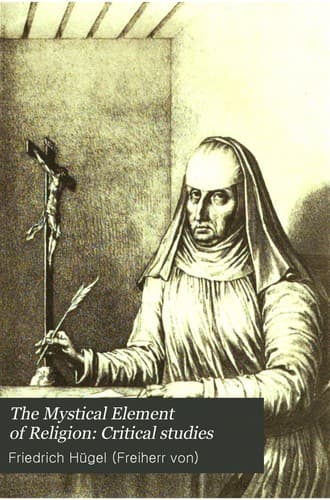
The Mystical Element of Religion, as studied in Saint Catherine of Genoa and her friends, Volume 2 (of 2)Hügel, Friedrich, Freiherr von
Religion
The Mystical Element of Religion, as studied in Saint Catherine of Genoa and her friends, Volume 2 (of 2)
Hügel, Friedrich, Freiherr von
Catherine, of Genoa, Saint, 1447-1510
Not so, in proportion as the mystic is great and spiritual, and as
he here still clings to the principles common to all true religion.
For, in proportion as he is and does this, will he find and regard the
mind as deeper and more operative than sense, and God’s Spirit as
penetrating and transcending both the one and the other. And hence he
will (at least implicitly) regard those psycho-physical impressions
as but sense-like and really mental; and he will consider this mental
impression and projection as indeed produced by the presence and
action of the Spirit within his mind or of the pressure of spiritual
realities upon it, but will hold that this whole mental process, with
these its spacial- and temporal-seeming embodiments, these sights and
sounds, has only a relation and analogical likeness to, and is not
and cannot be identical with, those realities of an intrinsically
super-spacial, super-temporal order.--And thus here as everywhere,
although here necessarily more than ever, we find again the conception
of the Transcendent yet also Immanent Spirit, effecting in the human
spirit the ever-increasing apprehension of Himself, accompanied in
this spirit by an ever keener sense of His incomprehensibility for all
but Himself. And here again the truth, and more especially the divine
origin of these apprehensions, is tested and guaranteed on and on by
the consequent deepening of that spiritual and ethical fruitfulness and
death to self, which are the common aspirations of every deepest moment
and every sincerest movement within the universal heart of man.
Thus, as regards the mentality of these experiences, Catherine
constantly speaks of seeing “as though with the eyes of the body.” And
St. Teresa tells us of her visions with “the eyes of the soul”; of
how at first she “did not know that it was possible to see anything
otherwise than with the eyes of the body”; of how, in reality “she
never,” in her true visions and locutions, “saw anything with her
bodily eyes, nor heard anything with her bodily ears”; and of how
indeed she later on, on one occasion, “saw nothing with the eyes of
the body, nothing with the eyes of the soul,”--she “simply felt Christ
close by her,”--evidently again with the soul. Thus, too, Catherine
tells us, that “as the intellect exceeds language, so does love exceed
intellection”; and how vividly she feels that “all that can be said of
God,” compared to the great Reality, “is but tiny crumbs from the great
Master’s table.”[49]
Public-domain text, read in full here on John Shaqi.
Reviews
Reviews
No reviews yet
Be the first to share your thoughts on this work.
Join the Discussion
Join the discussion
Sign in to leave a comment or review.
Sign InorCreate an account