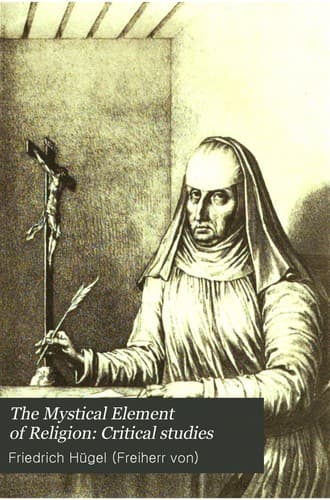
The Mystical Element of Religion, as studied in Saint Catherine of Genoa and her friends, Volume 2 (of 2)Hügel, Friedrich, Freiherr von
Religion
The Mystical Element of Religion, as studied in Saint Catherine of Genoa and her friends, Volume 2 (of 2)
Hügel, Friedrich, Freiherr von
Catherine, of Genoa, Saint, 1447-1510
The second special difficulty is this. Have not at least some of the
saints of this definitely ecstatic type shown more psycho-physical
abnormality than spiritually fruitful origination or utilization of
such things, so that their whole life seems penetrated by a fantastic
spirit? And have not many others, who, at their best, may not have been
amenable to this charge, ended with shattered nerve- and will-power,
with an organism apparently incapable of any further growth or use,
even if we restrict our survey exclusively to strength-bringing ecstasy
and to a contemplative prayer of some traceable significance?
(1) As a good instance of the apparent predominance of psycho-physical
and even spiritual strangeness, we can take the Venerable Sister
Lukardis, Cistercian Nun of Ober-Weimar, born probably in 1276.
Her life is published from a unique Latin MS. by the Bollandists
(_Analecta_, Vol. XVIII, pp. 305-367, Bruxelles, 1899), and presents us
with a mediaevally naïve and strangely unanalytic, yet extraordinarily
vivid picture of things actually seen by the writer. “Although,” say
the most competent editors, “we know not the name nor profession of
the Author, whether he belonged to the Friars or to the Monks,[51] it
is certain that he was a contemporary of Lukardis, that he knew her
intimately, and that he learnt many details from her fellow-nuns. And
though we shall be slow to agree with him when he ascribes all the
strange things which she experienced in her soul and body to divine
influence, yet we should beware of considering him to be in bad faith.
For, though he erred perchance in ascribing to a divine operation
things which are simply the work of nature, such a vice is common
amongst those who transmit such things.”[52] I take the chief points in
the order of their narration by the _Vita_.
“Soon after Lukardis had, at twelve years of age, taken the Cistercian
habit, her mother died,” over twelve English miles away, at Erfurt, yet
Lukardis “saw the scene” in such detail “in the spirit,” that, when
her sister came to tell her, she, Lukardis, “anticipated her with an
account of the day, the place and hour of the death, of the clothes
then being worn by their mother, of the precise position of the bed and
of the hospital, and of the persons present at the time.”
Public-domain text, read in full here on John Shaqi.
Reviews
Reviews
No reviews yet
Be the first to share your thoughts on this work.
Join the Discussion
Join the discussion
Sign in to leave a comment or review.
Sign InorCreate an account