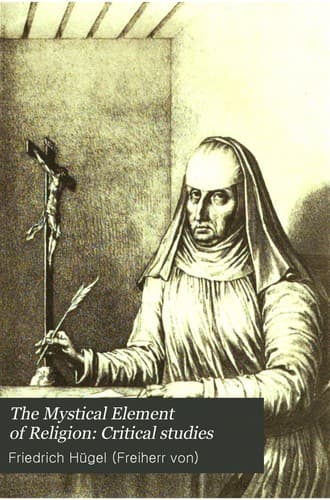
The Mystical Element of Religion, as studied in Saint Catherine of Genoa and her friends, Volume 2 (of 2)Hügel, Friedrich, Freiherr von
Religion
The Mystical Element of Religion, as studied in Saint Catherine of Genoa and her friends, Volume 2 (of 2)
Hügel, Friedrich, Freiherr von
Catherine, of Genoa, Saint, 1447-1510
(5) And everything that has happened and is happening in the world
of psychological and philosophical research, in the world of
historico-critical investigation into the past history and modalities
of religion, and in the world of our own present religious experience
and requirements, has but brought to light fresh facts, forces,
and connections, in proof both of the right and irreplaceableness
of the Mystical element in life and religion, and of the reality
and constant presence of these its two dangers. For, as to these
dangers, we now know, with extraordinary clearness and certainty, how
necessary, constant and far-reaching is, on its phenomenal surface,
the auto-suggestive, mono-ideistic power and mechanism of the mind;
yet how easily, in some states, too much can be made of such vivid
apprehensions and quasi-sensible imagings of invisible reality,--things
admirable as means, ruinous as ends. And we also know, with an
astonishing universality of application, how great a multiplicity in
unity is necessarily presented by every concrete object and by every
mental act and emotional state of every sane human being throughout
every moment of his waking life; and how this unity is actually
constituted and measured by the multiplicity of the materials and
by the degree of their harmonization.--Hence, not the absence of
the Mystical element, but the presence both of it and of the other
constituents of religion, will turn out to be the safeguard of our
deepest life and of its sanity, a sanity which demands a balanced
fulness of the soul’s three fundamental pairs of activities: sensible
perception and picturing memory; reflection, speculative and analytic;
and emotion and volition, all issuing in interior and exterior acts,
and these latter, again, providing so much fresh material and occasions
for renewed action and for a growing unification in an increasing
variety, on and on.
The metaphysical and faith questions, necessarily raised by the
phenomenal facts and mechanisms here considered, but which cannot
be answered at this level, will be discussed in a later chapter.
Here we can but once more point out, in conclusion, that no amount
of admitted or demonstrated auto-suggestion or mono-ideism in the
phenomenal reaches and mechanism of the mind decides, of itself,
anything whatsoever about, and still less against, the objective truth
and spiritual value of the ultimate causes, dominant ideas, and final
results of the process; nor as to whether and how far the whole great
movement is, at bottom, occasioned and directed by the Supreme Spirit,
God, working, in and through man, towards man’s apprehension and
manifestation of Himself.[60]
CHAPTER X
THE MAIN LITERARY SOURCES OF CATHERINE’S CONCEPTIONS
INTRODUCTORY.
1. _The main literary sources of Catherine’s teaching are four._
Public-domain text, read in full here on John Shaqi.
Reviews
Reviews
No reviews yet
Be the first to share your thoughts on this work.
Elsewhere in the archive
Join the Discussion
Join the discussion
Sign in to leave a comment or review.
Sign InorCreate an account