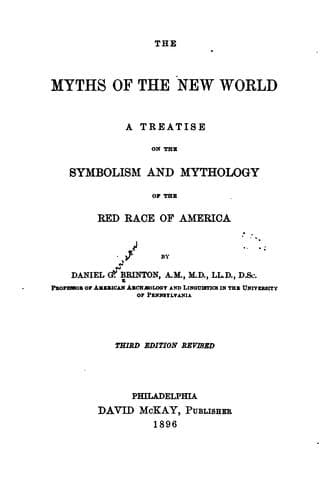
The Myths of the New World: A Treatise on the Symbolism and Mythology of the Red Race of AmericaBrinton, Daniel G. (Daniel Garrison)
Religion
The Myths of the New World: A Treatise on the Symbolism and Mythology of the Red Race of America
Brinton, Daniel G. (Daniel Garrison)
Indian mythology; Indians -- Folklore
No one is ignorant how widely this belief was prevalent in the old
world, nor how the quadrigesimal is still a sacred term with some
denominations of Christianity. But a more striking parallelism awaits
us. The symbol that beyond all others has fascinated the human mind, THE
CROSS, finds here its source and meaning. Scholars have pointed out its
sacredness in many natural religions, and have reverently accepted it as
a mystery, or offered scores of conflicting and often debasing
interpretations. It is but another symbol of the four cardinal points,
the four winds of heaven. This will luminously appear by a study of its
use and meaning in America.
The Catholic missionaries found it was no new object of adoration to the
red race, and were in doubt whether to ascribe the fact to the pious
labors of Saint Thomas or the sacrilegious subtlety of Satan. It was the
central object in the great temple of Cozumel, and is still preserved on
the bas-reliefs of the ruined city of Palenque. From time immemorial it
had received the prayers and sacrifices of the Aztecs and Toltecs, and
was suspended as an august emblem from the walls of temples in Popoyan
and Cundinamarca. In the Mexican tongue it bore the significant and
worthy name "Tree of Our Life," or "Tree of our Flesh" (Tonacaquahuitl).
It represented the god of rains and of health, and this was everywhere
its simple meaning. "Those of Yucatan," say the chroniclers, "prayed to
the cross as the god of rains when they needed water." The Aztec goddess
of rains bore one in her hand, and at the feast celebrated to her honor
in the early spring victims were nailed to a cross and shot with arrows.
Quetzalcoatl, god of the winds, bore as his sign of office "a mace like
the cross of a bishop;" his robe was covered with them strown like
flowers, and its adoration was throughout connected with his
worship.[96-1] When the Muyscas would sacrifice to the goddess of waters
they extended cords across the tranquil depths of some lake, thus
forming a gigantic cross, and at their point of intersection threw in
their offerings of gold, emeralds, and precious oils.[96-2] The arms of
the cross were designed to point to the cardinal points and represent
the four winds, the rain bringers. To confirm this explanation, let us
have recourse to the simpler ceremonies of the less cultivated tribes,
and see the transparent meaning of the symbol as they employed it.
Public-domain text, read in full here on John Shaqi.
Reviews
Reviews
No reviews yet
Be the first to share your thoughts on this work.
Join the Discussion
Join the discussion
Sign in to leave a comment or review.
Sign InorCreate an account