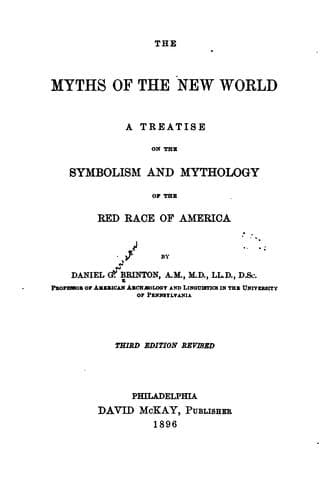
The Myths of the New World: A Treatise on the Symbolism and Mythology of the Red Race of AmericaBrinton, Daniel G. (Daniel Garrison)
Religion
The Myths of the New World: A Treatise on the Symbolism and Mythology of the Red Race of America
Brinton, Daniel G. (Daniel Garrison)
Indian mythology; Indians -- Folklore
When the rain maker of the Lenni Lenape would exert his power, he
retired to some secluded spot and drew upon the earth the figure of a
cross (its arms toward the cardinal points?), placed upon it a piece of
tobacco, a gourd, a bit of some red stuff, and commenced to cry aloud to
the spirits of the rains.[96-3] The Creeks at the festival of the Busk,
celebrated, as we have seen, to the four winds, and according to their
legends instituted by them, commenced with making the new fire. The
manner of this was "to place four logs in the centre of the square, end
to end, forming a cross, the outer ends pointing to the cardinal points;
in the centre of the cross the new fire is made."[97-1]
As the emblem of the winds who dispense the fertilizing showers it is
emphatically the tree of our life, our subsistence, and our health. It
never had any other meaning in America, and if, as has been said,[97-2]
the tombs of the Mexicans were cruciform, it was perhaps with reference
to a resurrection and a future life as portrayed under this symbol,
indicating that the buried body would rise by the action of the four
spirits of the world, as the buried seed takes on a new existence when
watered by the vernal showers. It frequently recurs in the ancient
Egyptian writings, where it is interpreted _life_; doubtless, could we
trace the hieroglyph to its source, it would likewise prove to be
derived from the four winds.
While thus recognizing the natural origin of this consecrated symbol,
while discovering that it is based on the sacredness of numbers, and
this in turn on the structure and necessary relations of the human
body, thus disowning the meaningless mysticism that Joseph de Maistre
and his disciples have advocated, let us on the other hand be equally on
our guard against accepting the material facts which underlie these
beliefs as their deepest foundation and their exhaustive explanation.
That were but withered fruit for our labors, and it might well be asked,
where is here the divine idea said to be dimly prefigured in mythology?
The universal belief in the sacredness of numbers is an instinctive
faith in an immortal truth; it is a direct perception of the soul, akin
to that which recognizes a God. The laws of chemical combination, of the
various modes of motion, of all organic growth, show that simple
numerical relations govern all the properties and are inherent to the
very constitution of matter; more marvellous still, the most recent and
severe inductions of physicists show that precisely those two numbers on
whose symbolical value much of the edifice of ancient mythology was
erected, the _four_ and the _three_, regulate the molecular distribution
of matter and preside over the symmetrical development of organic forms.
This asks no faith, but only knowledge; it is science, not revelation.
In view of such facts is it presumptuous to predict that experiment
itself will prove the truth of Kepler's beautiful saying: "The universe
Public-domain text, read in full here on John Shaqi.
Reviews
Reviews
No reviews yet
Be the first to share your thoughts on this work.
Join the Discussion
Join the discussion
Sign in to leave a comment or review.
Sign InorCreate an account