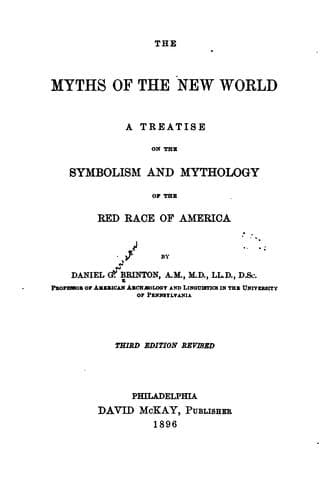
The Myths of the New World: A Treatise on the Symbolism and Mythology of the Red Race of AmericaBrinton, Daniel G. (Daniel Garrison)
Religion
The Myths of the New World: A Treatise on the Symbolism and Mythology of the Red Race of America
Brinton, Daniel G. (Daniel Garrison)
Indian mythology; Indians -- Folklore
[88-1] Sahagun, _Hist. de la Nueva España_, lib. iii. cap. iii.
[88-2] _Le Livre Sacré des Quichés_, Introd., p. clviii.
[89-1] Memorial de Tecpan Atitlan, in Brasseur, _Hist. du Mexique_, i. p.
167. The derivation of Tulan, or Tula, is extremely uncertain. The Abbé
Brasseur sees in it the _ultima Thule_ of the ancient geographers, which
suits his idea of early American history. Hernando De Soto found a
village of this name on the Mississippi, or near it. But on looking into
Gallatin's vocabularies, _tulla_ turns out to be the Choctaw word for
_stone_, and as De Soto was then in the Choctaw country, the coincidence
is explained at once. Buschmann, who spells it _Tollan_, takes it from
_tolin_, a rush, and translates, _juncetum_, _Ort der Binsen. Ueber die
Aztekischen Orstnamen_,[TN-2] p. 682. Those who have attempted to make
history from these mythological fables have been much puzzled about the
location of this mystic land. Humboldt has placed it on the northwest
coast, Cabrera at Palenque, Clavigero north of Anahuac, etc. etc. Aztlan,
literally, the White Land, is another name of wholly mythical purport,
which it would be equally vain to seek on the terrestrial globe. In the
extract in the text, the word translated God is _Qabavil_, an old word
for the highest god, either from a root meaning to open, to disclose, or
from one of similar form signifying to wonder, to marvel; literally,
therefore, the Revealer, or the Wondrous One (_Vocab. de la Lengua
Quiché_, p. 209: Paris, 1862).
[90-1] Ximenes, _Or. de los Indios_, p. 80, _Le Livre Sacré_, p. 195.
[90-2] Garcia, _Origen de los Indios_, lib. iv. cap. 4.
[91-1] Compare the German expression _sich orientiren_, to right oneself
by the east, to understand one's surroundings.
[92-1] Hawkins, _Sketch of the Creek Country_, p. 80.
[92-2] See Jacob Grimm, _Geschichte der Deutschen Sprache_, p. 681
[92-3] De Smet, Oregon Missions, p. 352.
[93-1] Bressani, _Relation Abrégé_, p. 93.
[93-2] Venegas, _Hist. of California_, i. p. 91: London, 1759.
[93-3] Cogolludo, _Hist. de Yucathan_, lib. iv. cap. iii.
[93-4] Alexander von Humboldt has asserted that the Quichuas had other
and very circumstantial terms to express the cardinal points drawn from
the positions of the son (_Ansichten der Natur_, ii. p. 368). But the
distinguished naturalist overlooked the literal meaning of the phrases he
quotes for north and south, _intip chaututa chayananpata_ and _intip
chaupunchau chayananpata_, literally, the sun arriving toward the
midnight, the sun arriving toward the midday. These are evidently
translations of the Spanish _hacia la media noche_, _hacia el medio dia_,
for they could not have originated among a people under or south of the
equatorial line.
[94-1] Catlin, _Letters and Notes_, i., Letter 22; La Hontan, _Mémoires_,
ii. p. 151; Gumilla, _Hist. del Orinoco_, p. 159
Public-domain text, read in full here on John Shaqi.
Reviews
Reviews
No reviews yet
Be the first to share your thoughts on this work.
Join the Discussion
Join the discussion
Sign in to leave a comment or review.
Sign InorCreate an account