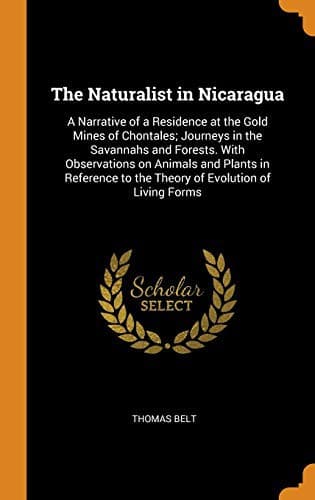
Natural history -- Nicaragua; Nicaragua -- Description and travel
large freshwater sharks appear to be common in the lake. Sometimes,
when in shallow water, we saw a pointed billow rapidly moving away
from the boat, produced by some large fish below, and I was told it
was a shark.
After dark the wind failed us again, and we got slowly along, but
finally reached our port, San Ubaldo, about ten o'clock, and found
an officer of the mining company, living in a small thatched hut,
stationed there to send on the machinery and other goods that
arrived for the mines. A large tiled store had also just been built
by the owner of the estate there, Don Gregorio Quadra, under the
verandah of which I hung my hammock for the night. Mules were
waiting at San Ubaldo for us, and early next morning we set off,
with our luggage on pack mules. We crossed some rocky low hills,
with scanty vegetation, and, after passing the cattle hacienda of
San Jose, reached the plains of the same name, about two leagues in
width, now dry and dusty, but in the wet season forming a great
slough of water and tenacious mud, through which the mules have to
wade and plunge.
In the midst of these plains there are some rocky knolls, like
islands, on which grow spiny cactuses, low leathery-leaved trees,
slender, spiny palms, with plum-like fruit, prickly acacias, and
thorny bromelias. This spiny character of vegetation seems to be
characteristic of dry rocky places and tracts of country liable to
great drought. Probably it is as a protection from herbivorous
animals, to prevent them browsing upon the twigs and small branches
where herbaceous vegetation is dried up. Small armadillos abound
near these rocky knolls, and are said to feed on ants and other
insects. We had a long chase after one, which we observed some
distance from the rock, over the cracked and dried-up plain: though
it could not run very fast, it doubled quickly, and the rough
cracked ground made odds in its favour; but it was ultimately
secured. Pigeons, brown coloured, of various sizes, from that of a
thrush to that of a common dove, were numerous and very tame. One
of the smallest species alights and seeks about in the streets of
small towns for seeds, like a sparrow, and more boldly than that
bird, for it is not molested by the children--more perhaps from
indolence than from any lack of the element of cruelty in their
dispositions. After crossing the plains we rode over undulating
hills, here called savannahs, with patches of forest on the rising
ground, and small plains on which grows the ternate-leaved jicara
(pronounced hickory), a tree about as large as an apple-tree, with
fruit of the size, shape, and appearance of a large green orange,
but growing on the trunk and branches, not amongst the leaves. The
outside of the fruit is a hard thin shell, packed full of seeds in
a kind of dry pulp, on which are fed fowls, and even horses and
cattle in the dry season; the latter are said sometimes to choke
themselves with the fruit, whilst trying to eat it. Of the bruised
Public-domain text, read in full here on John Shaqi.
Reviews
Reviews
No reviews yet
Be the first to share your thoughts on this work.
Join the Discussion
Join the discussion
Sign in to leave a comment or review.
Sign InorCreate an account