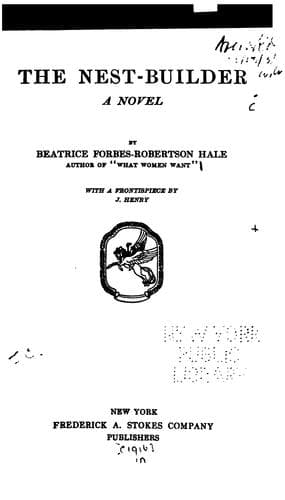
The Nest Builder: A NovelHale, Beatrice Forbes-Robertson
General
The Nest Builder: A Novel
Hale, Beatrice Forbes-Robertson
Marriage -- Fiction
As Christmas approached they began to make acquaintances among the
polyglot population of the neighborhood. Their old hotel, the culinary
aristocrat of the district, possessed a cafe in which, with true French
hospitality, patrons were permitted to occupy tables indefinitely on
the strength of the slenderest orders. Here for the sake of the
French atmosphere Stefan would have dined nightly had Mary's frugality
permitted. As it was, they began to eat there two or three nights a
week, and dropped in after dinner on many other nights. They would
sit at a bare round table smoking their cigarettes, Mary with a cup of
coffee, Stefan with the liqueur he could never induce her to share, and
watching the groups that dotted the other tables. Or they would linger
at the cheapest of their restaurants and listen to the conversation of
the young people, aggressively revolutionary, who formed its clientele.
These last were always noisy, and assumed as a pose manners even worse
than those they naturally possessed. Every one talked to every one else,
regardless of introductions, and Stefan had to summon his most crushing
manner to prevent Mary from being monopolized by various very youthful
and visionary men who openly admired her. He was inclined to abandon
the place, but Mary was amused by it for a time, bohemianism being a
completely unknown quantity to her.
“Don't think this is the real thing,” he explained; “I've had seven
years of that in Paris. This is merely a very crass imitation.”
“Imitation or not, it's most delightfully absurd and amusing,” said
she, watching the group nearest her. This consisted of a very short and
rotund man with hair a la Paderewski and a frilled evening shirt, a thin
man of incredible stature and lank black locks, and a pretty young
girl in a tunic, a tam o' shanter, enormous green hairpins, and tiny
patent-leather shoes decorated with three inch heels. To her the lank
man, who wore a red velvet shirt and a khaki-colored suit reminiscent of
Mr. Bernard Shaw, was explaining the difference between syndicalism and
trade-unionism in the same conversational tone which men in Lindum had
used in describing to Mary the varying excellences of the two local
hunts. “I.W.W.” and “A.F. of L.” fell from his lips as “M.F.H.”
and “J.P.” used to from theirs. The contrast between the two worlds
entertained her not a little. She thought all these young people looked
clever, though singularly vulgar, and that her old friends would have
appeared by comparison refreshingly clean and cultivated, but quite
stupid.
“Why, Stefan, are dull, correct people always so clean, and clever and
original ones usually so unwashed?” she wondered.
“Oh, the unwashed stage is like the measles,” he replied; “you are bound
to catch it in early life.”
“I suppose that's true. I know even at Oxford the Freshmen go through
an utterly ragged and disreputable phase, in which they like to pretend
they have no laundry bill.”
Public-domain text, read in full here on John Shaqi.
Reviews
Reviews
No reviews yet
Be the first to share your thoughts on this work.
Elsewhere in the archive
Join the Discussion
Join the discussion
Sign in to leave a comment or review.
Sign InorCreate an account