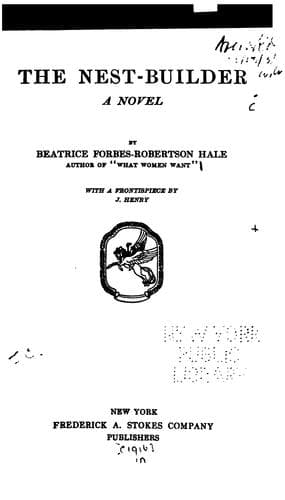
The Nest Builder: A NovelHale, Beatrice Forbes-Robertson
General
The Nest Builder: A Novel
Hale, Beatrice Forbes-Robertson
Marriage -- Fiction
One of Mary's first after dinner friendships was made at the hotel with
a certain Mrs. Elliott, who turned out to be the President of the local
Suffrage Club. Scenting a new recruit, this lady early engaged the Byrds
in conversation and, finding Mary a believer, at once enveloped her in
the camaraderie which has been this cause's gift to women all the world
over. They exchanged calls, and soon became firm friends.
Mrs. Elliot was an attractive woman in middle life, of slim, graceful
figure and vivacious manner. She had one son out in the world, and one
in college, and lived in a charming house just off the Avenue, with
an adored but generally invisible husband, who was engaged in business
downtown. As a girl Constance Elliot had been on the stage, and had
played smaller Shakespearean parts in the old Daly Company, but, bowing
to the code of her generation, had abandoned her profession at marriage.
Now, in middle life, too old to take up her calling again with any hope
of success, yet with her mental activity unimpaired, she found in the
Suffrage movement her one serious vocation.
“I am nearly fifty, Mrs. Byrd,” she said to Mary, “and have twenty good
years before me. I like my friends, and am interested in philanthropy,
but I am not a Jack-of-all-trades by temperament. I need work--a real
job such as I had when the boys were little, or when I was a girl. We
are all working hard enough to win the vote, but what we shall fill the
hole in our time with when we have it, I don't know. It will be easy for
the younger ones--but I suppose women like myself will simply have to
pay the price of having been born of our generation. Some will find
solace as grandmothers--I hope I shall. But my elder son, who married a
pretty society girl, is childless, and my younger such a light-hearted
young rascal that I doubt if he marries for years to come.”
Mary was much interested in this problem, which seemed more salient here
than in her own class in England, in which social life was a vocation
for both sexes.
At Mrs. Elliot's house she met many of the neighborhood's more
conventional women, and began to have a great liking for these gently
bred but broad-minded and democratic Americans. She also met a mixed
collection of artists, actresses, writers, reformers and followers of
various “isms”; for as president of a suffrage club it was Mrs. Elliot's
policy to make her drawing rooms a center for the whole neighborhood.
She was a charming hostess, combining discrimination with breadth of
view; her Fridays were rallying days for the followers of many more
cults than she would ever embrace, but for none toward which she could
not feel tolerance.
Public-domain text, read in full here on John Shaqi.
Reviews
Reviews
No reviews yet
Be the first to share your thoughts on this work.
Elsewhere in the archive
Join the Discussion
Join the discussion
Sign in to leave a comment or review.
Sign InorCreate an account