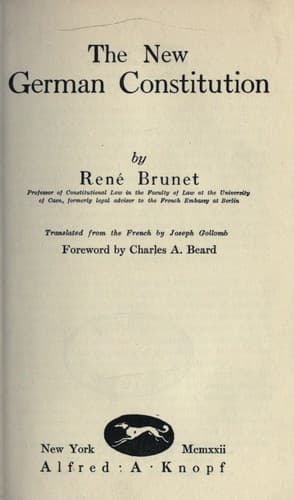
Germany -- Politics and government -- 1918-1933; Germany. Verfassung (1919)
A parliamentary system--the proof is at hand--is powerless to bring about
the triumph of social democracy. The revolution throughout the world, if
it is to win quickly--and it must win quickly, for the proletariat can
no longer wait--cannot achieve its aims except by other methods. As in
Russia in 1905 and in 1917, so in Germany the necessary change can be
only the product of Workers Councils. It is only within the Councils that
the union of the proletariat is possible. Only the Councils assure the
co-operation of manual and of intellectual workers, which Russia had not
been able as yet to realize but which should be and can be accomplished.
The system of Councils in its final aspect realizes the most perfect
form of democracy, for it gives political and economic equality to all
its citizens. While waiting its ultimate triumph, however, it may be
necessary to proclaim the dictatorship of the proletariat; but this
dictatorship will not be any heavier than that which is borne by the
proletariat itself. It will last if necessary till the complete fusion
of social classes does away with the class struggle, till the advent of
integral socialism.
Therefore, all power to the Councils! No division of influence, no
juxtaposition of political assemblies and economic councils! The Councils
are an indispensable instrument to substitute permanently a socialist
for a capitalist régime. That is to say, they should fulfil two series
of functions: political and economic. Politically the Councils system
unites in the same organism both parliament and administration, thus
rendering possible that constant control of administration which the
parliamentary régime is incapable of exercising, and maintaining a
permanent supervision of the elected by the electors. Economically the
Councils watch over the execution of socialization measures; later they
become the regulators of production and consumption.
To this duality of functions there corresponds a double organization.
The political system rests on Workers Councils properly so called
(Arbeiterräte); the economic system rests on Factory Workers Councils
(Betriebsräte).
Public-domain text, read in full here on John Shaqi.
Reviews
Reviews
No reviews yet
Be the first to share your thoughts on this work.
Join the Discussion
Join the discussion
Sign in to leave a comment or review.
Sign InorCreate an account