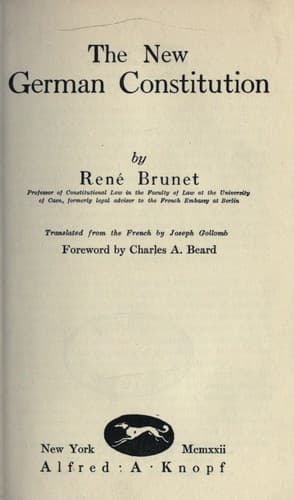
Germany -- Politics and government -- 1918-1933; Germany. Verfassung (1919)
In each commune, workers, employés, and peasants, organized as much
as possible in vocational groups, elect worker councillors, one for
every 1,000 electors. These councillors have as their task, while
awaiting the final organization of the system of Councils, the control
of municipal administration. Their delegates constitute Local Councils
(Kreisarbeiterräte); the delegates of the latter, in turn, make up
District Councils (Bezirksräte). In addition, so long as the German
Republic is still not united, there will sit in the capital of each state
a Central Council (Landeszentralrat). These different organizations are
respectively charged with the control of administration of each degree of
the hierarchy. At the summit of the edifice, finally, sits the Congress
of Councils, which controls all political power, and whose meetings must
take place at least every three months. This congress elects a Central
Council (Zentralrat) which appoints and controls the Commissars of the
People. It is in a word a copy of the Russian system.
Parallel to this political organization, there is created in each
factory, shop, etc., a Factory Workers Council (Betriebsrat), elected
by the workers and employés in the proportion of one delegate to 100
electors. Small factories and rural enterprises are grouped so as to
form electoral units; the same with the professions. The Factory Workers
Councils are charged with the defence of the interests of the personnel,
and with the control of the enterprises in which they are employed.
They co-operate in the application of measures for socialization. But
their action, limited to the factory or the shop, cannot pretend to
embrace all the problems of production. Germany is divided, therefore,
into a certain number of economic districts (Wirtschaftsbezirke). In
each of these districts the Factory Workers Councils of each branch of
industry and of commerce designate a Council of Groups of this district
(Bezirksgrupenrat). All the Councils of Groups in the same district
designate delegates whose assembly constitutes the Economic Council of
that district (Bezirkswirtschaftsrat). In the same way the district
Councils of Groups of each branch of industry elect for the whole Reich
a Council of Groups of the Reich (Reichswirtschaftsrat), to which is
entrusted the general supervision of economic life, and which, in accord
with the Central Council, determines during the transitional period the
necessary measures for the maintenance of production and the application
of the laws for socialization. The Economic Councils of the districts and
the National Council may add to themselves, if they deem fit, experts,
economists, etc.
Public-domain text, read in full here on John Shaqi.
Reviews
Reviews
No reviews yet
Be the first to share your thoughts on this work.
Join the Discussion
Join the discussion
Sign in to leave a comment or review.
Sign InorCreate an account