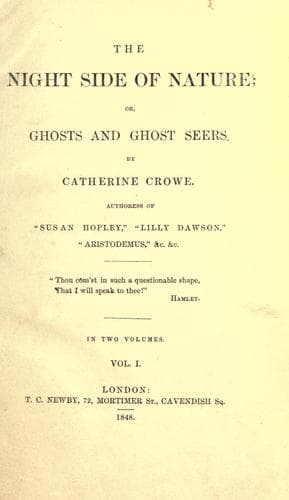
The Night-Side of Nature; Or, Ghosts and Ghost-SeersCrowe, Catherine
Religion
The Night-Side of Nature; Or, Ghosts and Ghost-Seers
Crowe, Catherine
Ghosts; Parapsychology
A circumstance, exactly similar to this, is related by Stilling, of
Professor Böhm, teacher of mathematics at Marburg; who being one evening
in company, was suddenly seized with a conviction that he ought to go
home. As however, he was very comfortably taking his tea, and had
nothing to do at home, he resisted the admonition; but it returned with
such force that at length he was obliged to yield. On reaching his
house, he found everything as he had left it; but he now felt himself
urged to remove his bed from the corner in which it stood to another;
but as it had always stood there, he resisted this impulsion also.
However, the resistance was vain, absurd as it seemed, he felt he must
do it; so he summoned the maid, and with her aid, drew the bed to the
other side of the room; after which he felt quite at ease and returned
to spend the rest of the evening with his friends. At ten o’clock the
party broke up, and he retired home and went to bed and to sleep. In the
middle of the night, he was awakened by a loud crash, and on looking
out, he saw that a large beam had fallen, bringing part of the ceiling
with it, and was lying exactly on the spot his bed had occupied.
A young servant-girl in this neighborhood, who had been several years in
an excellent situation, where she was much esteemed, was suddenly seized
with a presentiment that she was wanted at home; and, in spite of all
representations, she resigned her place, and set out on her journey
thither; where, when she arrived, she found her parents extremely ill,
one of them mortally, and in the greatest need of her services. No
intelligence of their illness had reached her, nor could she herself in
any way account for the impulse. I have heard of numerous
well-authenticated cases of people escaping drowning from being seized
with an unaccountable presentiment of evil when there were no external
signs whatever to justify the apprehension. The story of Cazotte, as
related by La Harpe, is a very remarkable instance of this sort of
faculty; and seems to indicate a power like that possessed by Zschokke,
who relates, in his autobiography, that frequently while conversing with
a stranger, the whole circumstances of that person’s previous life were
revealed to him, even comprising details of places and persons. In the
case of Cazotte, it was the future that was laid open to him, and he
foretold, to a company of eminent persons, in the year 1788, the fate
which awaited each individual, himself included, in consequence of the
revolution then commencing. As this story is already in print, I forbear
to relate it.
Public-domain text, read in full here on John Shaqi.
Reviews
Reviews
No reviews yet
Be the first to share your thoughts on this work.
Join the Discussion
Join the discussion
Sign in to leave a comment or review.
Sign InorCreate an account