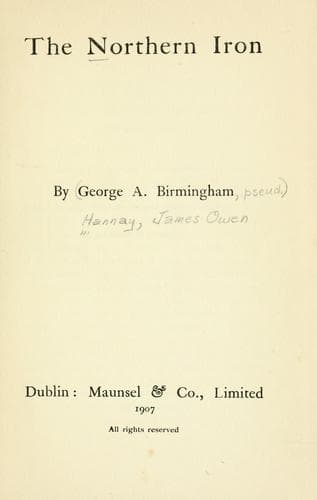
Historical fiction; Ireland -- History -- Rebellion of 1798 -- Fiction
Neal lingered so long in the company of these new friends that it was
far on in the afternoon when he started on his ride, and late in the
evening when he arrived in the outskirts of Belfast. It was his first
visit to the town, and he approached it with feelings of interest
and curiosity. Riding down the long hill by which the road from
Templepatrick approaches Greencastle on the way to the town, he was able
to gaze over the waters of the lough which lay stretched beneath him on
his left. In the Carrickfergus roads several ships lay at anchor, among
them a frigate of the English navy. Pinnaces and small craft plied
between them and the shore, or headed for the entrance of Belfast
Harbour by the tortuous channel worn through mud and sand by the Lagan.
Below him, by the sea, were the handsome houses which the richer class
of merchants were already beginning to build for themselves on the
shores of the lough. Between Carnmoney and Belfast he passed the bleach
greens of the linen weavers, where the long webs of the cloth, for which
Belfast was afterwards to become famous, lay white or yellow on the
grass. On his right rose the rugged sides of the Cave Hill. High above
its rocks towered MacArt’s fort, where Wolfe Tone, M’Cracken, Samuel
Neilson, and his new friend, James Hope, with others, had sworn the oath
of the United Irishmen. They had separated far from each other since the
day of their swearing, but each in his own way--Tone among the intrigues
of Continental politics, M’Cracken in Belfast, Neilson and Hope among
the Antrim peasantry--had kept the oath and would keep it until the end.
Entering the town, he passed the recently-erected poorhouse and
infirmary, a building designed with a curious spacious generosity, as
were the buildings in Dublin and elsewhere which Irishmen erected during
the short day of their national independence. In Donegall Street he saw
the new church--Ann’s Church, as the people called it---thinking rather
of the lady of Lord Donegall, who interested herself in its building,
than the Mother of the Virgin in whose honour good Protestants were
little likely to build a church. But the classic portico and tall tower
did not hold his attention long. He could not but notice that there was
an air of anxious excitement in the demeanour of the citizens who passed
him in the street. They were all hurrying one way, making from one
direction or another for the side street whose entrance faced the
church. Neal accosted one or two, but received either no answer or words
uttered so hurriedly that he could not catch their import. Determined
at length to get some intelligible reply to his questions, he pulled his
horse across the path of an elderly gentleman of respectable appearance.
“Will you tell me,” he said, “the way to North Street? I am a stranger
in your town.”
“And if you are a stranger you will do well to keep out of North Street
the night.”
Public-domain text, read in full here on John Shaqi.
Reviews
Reviews
No reviews yet
Be the first to share your thoughts on this work.
Join the Discussion
Join the discussion
Sign in to leave a comment or review.
Sign InorCreate an account