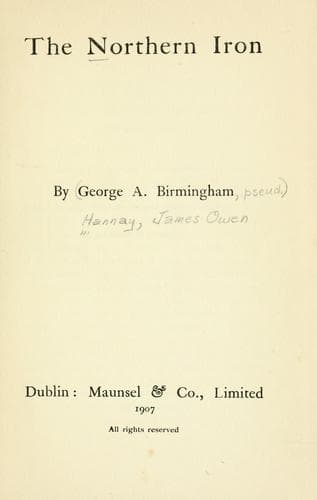
Historical fiction; Ireland -- History -- Rebellion of 1798 -- Fiction
Neal Ward was awakened next morning by the noise which Peg Macllrea made
sweeping and tidying the room where he slept. He lay for a few minutes
watching the girl. Her red hair was coiled up now in a neat roll at
the back of her head. Her freckled face was clean, and had apparently
escaped bruising in her conflict with the dragoon. She wore a short grey
skirt of woollen homespun. The sleeves of her bodice were rolled up, and
displayed a pair of muscular red arms. The girl was more than commonly
tall, and anyone listening to her heavy footfall, and noting her thick
figure and broad shoulders, would have understood that she was well able
to carry a young man, even of Neal’s height, up a flight of stairs. The
dragoon might easily have come to the worst in single combat with such
a maiden if he had not obtained an advantage over her at the start by
twisting her hair round his hand.
It was not very long before she noticed that Neal was awake. She came
over to him smiling.
“You’ve had a brave sleep,” she said. “It’s nigh on eleven o’clock. The
master and Mr. Ward are out this twa hours. They bid me not stir you.
I was just readying up the room a bit, and I went about it as mim as a
mouse.”
“I’m thinking,” said Neal, “that I’ll be getting up now.”
“‘Deed, then, and you’ll no. The last word the master said was just that
you were to lie in the day. I’m to give you tea and toasted bread, and
an egg if you fancy it.”
“But,” said Neal, “I can’t lie here in bed all day.”
“Whisht, now, whisht. Be good and I’ll get you them twa graven images
the master’s so set on and let you glower at them. Maybe you never seen
the like.”
She spoke precisely as if she had a sick child to humour; as if she were
the nurse in charge, determined at any sacrifice to keep the peevish
little one from crying. She crossed the room to a book-case and took
down two bronze busts. With the utmost care she carried them over and
laid them on the bed in front of Neal.
“The master’s one of them that goes neither to church nor mass nor
meeting,” she said. “If ever he says his prayers at all, at all, it’s
to them twa graven images he says them, and the dear knows they’re no so
eye-sweet.”
Public-domain text, read in full here on John Shaqi.
Reviews
Reviews
No reviews yet
Be the first to share your thoughts on this work.
Elsewhere in the archive
Join the Discussion
Join the discussion
Sign in to leave a comment or review.
Sign InorCreate an account