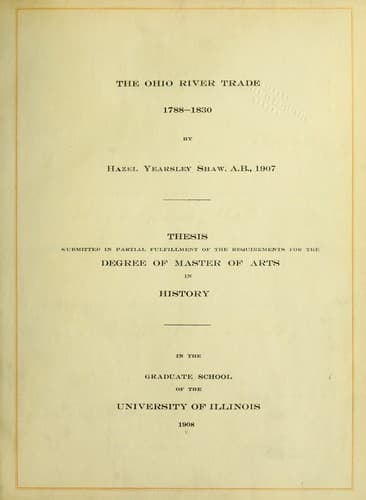
The Ohio River Trade, 1788-1830Shaw, Hazel Yearsley
History
The Ohio River Trade, 1788-1830
Shaw, Hazel Yearsley
Ohio River -- History; Ohio River Valley -- History
disuse,and about the year 1830, few were to be seen.[360]
In 1818, two thousand people were regularly employed as boatmen on
the Ohio, and they were proverbially ferocious and abandoned in
their habits, though possibly with many exceptions.[361] The shores
of the Monongahela in 1819, were lined with barges, keels, and arks
or flats, waiting for the rise of the Ohio.[362] During 1821-1823
flat bottoms, keels, and barges[363] found constant employment in the
carrying trade to and from New Orleans.[364] As late as 1828 or
1830, flats, arks, and barges were to be seen at New Orleans.[365]
The flats seem to have continued in the greatest numbers after the
introduction of the steamboat.
There were on the Ohio many other forms of craft which I shall
briefly mention. The Allegheny or Mackinaw skiff was a covered boat
carrying from six to ten tons.[366] "Dugouts," named from the manner
of making them, and canoes hollowed from trees were to be seen
in great numbers. These boats and skiffs were used to cross the
rivers, and a select company of travelers often descended the river
in them to New Orleans.[367] Flat boats, worked by a wheel, driven
by the cattle that they were conveying to New Orleans, were to be
seen; also horse boats of various construction, used for the most
part as ferry boats, but sometimes as boats of ascent.[368] Boats
moved rapidly up stream by wheels, after the steam construction,
propelled by a man turning a crank.[369] Flint says, "in this land
of freedom and invention, with a little aid perhaps, from the
influence of the moon, there are monstrous anomalies, reducible to
no specific class of boats, and only illustrating the whimsical
archetypes of things that have previously existed in the brain of
inventive men, who reject the slavery of being obliged to build
in any received form. You can scarcely imagine an abstract form
in which a boat can be built, that in some part of the Ohio or
Mississippi, you will not see, actually in motion."[370]
As the steamboat was perfected, and increased in numbers and
importance, many of these strange craft were destined to disappear,
and prior even to the year 1830, many of them began to be
superseded by the larger and more swiftly moved steamboats.
FOOTNOTES:
[314] Hall, J., Notes, 142-143.
[315] Howells, W. C., Recollections, 84-85.
[316] Howells, W. C., Recollections, 84-85.
[317] Hall, J., Letters, 87-88.
[318] Hulme, T., Journal, Early W. Travels, X., 39.
[319] Birkbeck, M., Letters, 119.
[320] Faux, W., Memorable Days, Early W. Travels, XI., 171.
[321] Birkbeck, M., Notes, 38.
[322] Ogden, G. W., Letters, Early W. Travels, XIX., 41.
[323] Hulme, T., Journal, Early W. Travels, X., 42.
[324] Flint, J., Letters, Early W. Travels, IX., 86.
[325] Tranchepain, Travels, 100-101.
[326] Flint, T., Recollections, 13-14.
[327] Flint, J., Letters, Early W. Travels, IX., 97.
[328] Ibid., IX., 147.
[329] Ibid., IX., 163.
Public-domain text, read in full here on John Shaqi.
Reviews
Reviews
No reviews yet
Be the first to share your thoughts on this work.
Join the Discussion
Join the discussion
Sign in to leave a comment or review.
Sign InorCreate an account