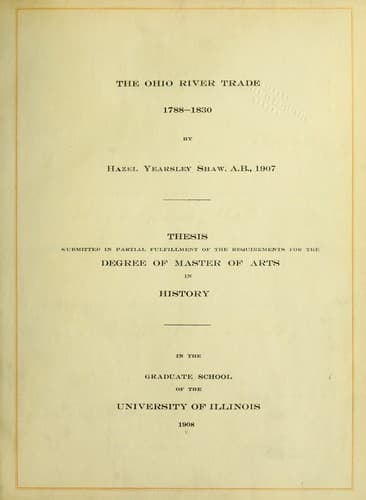
The Ohio River Trade, 1788-1830Shaw, Hazel Yearsley
History
The Ohio River Trade, 1788-1830
Shaw, Hazel Yearsley
Ohio River -- History; Ohio River Valley -- History
Retail trading boats continued in use on the Ohio. Every
considerable landing place on the Ohio and Mississippi, had in the
spring, a number of stationary and inhabited boats, lying by at the
shore. They were often dram shops.[344] Flint says, "While I was at
New Madrid, a large tinner's establishment floated there in a boat.
In it all the different articles of tinware were manufactured,
and sold by wholesale and retail.[345] A still more extraordinary
manufactory, we were told, was floating down the Ohio, and shortly
expected at New Madrid. Aboard this were manufactured axes,
scythes, and all other iron tools of this description, and in it
horses were shod. In short it was a complete blacksmith's shop of
a higher order. I have frequently seen in this region, a dry goods
shop in a boat, with its articles very handsomely arranged on
shelves."[346]
Keel boats were still used on the Mississippi and Ohio in low
stages of water, and on the boatable streams where steamboats did
not run. Before the introduction of the steamboat, there were six
times as many of these boats used as afterward.[347] These boats were
used to carry merchandise down the river, eight or ten boatmen
being required for a journey down stream,[348] and from twelve to
twenty-four to pole the boat up stream.[349] Emigrants sometimes
took passage down the Ohio in keel boats.[350] As early as 1817 the
steamboats were beginning to supersede them.[351]
Barges, varying from 40[352] to 170[353] tons burthen, were
used in the transportation of merchandise. About twenty[354] or
twenty-five[355] hands were required to work an ordinary barge
upstream, the boatmen being able to make about six or seven miles
per day against the current.[356] During the years 1812-1818
these barges were used to carry large cargoes both to and from
New Orleans.[357] These boats often were equipped with sails,
masts, and rigging. From ninety to one hundred days was a tolerable
passage from New Orleans to Cincinnati. In this way the intercourse
between Pittsburg, Cincinnati, Louisville, Nashville, and St.
Louis, for the more important purposes of commerce, was kept up
with New Orleans.[358] A rather interesting article appeared in
the Louisiana Gasette of October 24, 1815, which was as follows:
"The steamboats now in use cannot carry one twentieth part of
the goods that might be in demand from this city (N. O.)--the
common barges, always slow and expensive in their operations are
in a great measure paralyzed by the few steamboats in use, the
bargemen know that steamboats will always have the preference,
hence they are prevented from preparing barges, the expense being
great, and the barge owners generally men of very limited means,
so that the public will be worse served than if steam were not
in operation unless a spirit is immediately diffused that will
bring the steam navigation into use commensurate to the demand
of transportation."[359] As time went on the barges fell into
Public-domain text, read in full here on John Shaqi.
Reviews
Reviews
No reviews yet
Be the first to share your thoughts on this work.
Join the Discussion
Join the discussion
Sign in to leave a comment or review.
Sign InorCreate an account