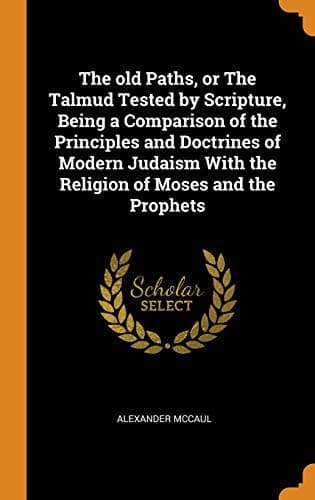
The old paths, or the Talmud tested by Scripture: Being a comparison of the principles and doctrines of modern Judaism with the religion of Moses and the prophetsMcCaul, Alexander
Religion
The old paths, or the Talmud tested by Scripture: Being a comparison of the principles and doctrines of modern Judaism with the religion of Moses and the prophets
McCaul, Alexander
Judaism -- Works to 1900
“A Noahite who is forced to transgress one of his commandments, it is
lawful for him to do so. Even if he be compelled to commit idolatry he
may commit it, for they are not commanded to sanctify God.” (Hilchoth
Melachim, c. x. 2.) So that, according to the Rabbies, the Noahite who
is compelled to commit murder, adultery, or even to deny his God, may do
it with impunity; he still belongs “to the pious of the nations of the
world,” and may have a share in the world to come. We confess that we
cannot see in this doctrine either charity or toleration. We can
discover only that narrowness of heart which characterizes the oral law.
In order to magnify themselves, and depreciate the other nations, the
Rabbies first swell out their own commandments to 613, and reduce the
commandments of the nations to seven. But not content with that, they
also strive to confine the glories of martyrdom to themselves, and tell
the Gentiles that God does not require them to sanctify His name. Can
such doctrine come from God? Is God the God of the Rabbinists only? We
grant that the Jews are his “peculiar people.” We acknowledge that “they
have much advantage every way”—that “they are beloved for the fathers’
sakes”—that the time is coming when “all that see them shall acknowledge
them that they are the seed whom the Lord has blessed.” But we still
think that God’s heart is large enough to comprehend us Gentiles too in
his love. We know that we are the work of His hand, and we trust that,
as He is our Father, he requires, and is pleased to see even in
Gentiles, the feelings of children, love and filial fear. And we found
this our faith on your Scriptures as well as ours. The Word of God tells
us that, long before there were any Rabbies in the world, He had a
gracious and tender care for all mankind. He promised to our first
parents a Saviour who should “bruise the serpent’s head.” He saved Noah
and his family, not one of whom was a Rabbi, from the deluge; and when
they came forth from the ark, He made a gracious covenant not with one
nation only, but “with all flesh,” and hung up on high a lovely and
glittering arch, from one end of the heavens to the other, that all the
habitants of earth might have a token of their Father’s love and learn
to look up to Him with humble confidence. When he chose Abraham and his
seed, it was not an act of partiality, but that in his seed all the
families of the earth might be blessed. He did not leave himself without
witness to the nations. He manifested himself to Job, and taught him
“that his Redeemer liveth,” and moved even the prophets of Israel to
predict again and again the happy times when, “from the rising of the
sun to the going down of the same, His name should be great among the
Gentiles, and in every place incense should be offered to his name, and
a pure offering; for my name shall be great among the heathen, saith the
Lord of hosts.” (Mal. i. 11.) Having this word, we reject the oral law
Public-domain text, read in full here on John Shaqi.
Reviews
Reviews
No reviews yet
Be the first to share your thoughts on this work.
Join the Discussion
Join the discussion
Sign in to leave a comment or review.
Sign InorCreate an account