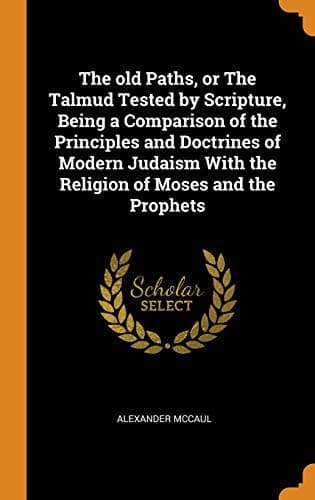
The old paths, or the Talmud tested by Scripture: Being a comparison of the principles and doctrines of modern Judaism with the religion of Moses and the prophetsMcCaul, Alexander
Religion
The old paths, or the Talmud tested by Scripture: Being a comparison of the principles and doctrines of modern Judaism with the religion of Moses and the prophets
McCaul, Alexander
Judaism -- Works to 1900
which contradicts it, and would make God the God of the Rabbinists only:
and we believe in the New Testament, which exactly agrees with your
written law, and asks, “Is he the God of the Jews only? Is he not also
of the Gentiles?”—and answers, “Yes, of the Gentiles also” (Rom. iii.
29)—and which also declares that, in the sight of God, “There is no
difference between the Jew and the Greek; for the same Lord over all is
rich unto all that call upon him, for whosoever shall call upon the name
of the Lord shall be saved.” (Rom. x. 12, 13.)
In the fixing of the commandments, then, for the sons of Noah, we have
detected an intolerant and uncharitable spirit very different from that
of the Old and New Testament. But we have further to inquire, what was
the extent of toleration conceded to them? We do not stop to prove that
they were not allowed to possess land, nor to be judges, nor members of
the Sanhedrin, nor to hold any office, nor to intermarry with the Jews.
From all that, they were excluded by the law of God himself. They were
allowed to sojourn in the land, and hence their name “sojourning
proselytes.” Further, “They were to be treated with the same courtesy
and benevolence as the Israelites.” (See No. 4, p. 26.) But further than
this the toleration did not extend. The oral law, though it commands
“courtesy and benevolence,” does not administer even-handed justice to
the “pious of the nations of the world,” as may be seen from the
following specimens:—
ישראל שהרג בשגגה את העבד או את גר תושב גולה .
וכן גר תושב שהרג את גר תושב או את העבד בשגגה גולה .
גר תושב שהרג את ישראל בשגגה אף על פי שהיה שוגג הרי זה נהרג .
“An Israelite who unintentionally kills a slave, or a sojourning
proselyte, is imprisoned (in one of the cities of refuge).”
“And so a sojourning proselyte who unintentionally kills a sojourning
proselyte, or a slave, is imprisoned.”
“A sojourning proselyte who unintentionally kills an Israelite, although
he did it unintentionally, is to be put to death.” (Hilchoth Rotzeach,
c. v. 3.) The written law, on the contrary, says, “These six cities
shall be a refuge, both for the children of Israel and for the stranger,
and for the sojourner among them: that any one that killeth any person
unawares may flee thither.” (Numbers xxxv. 15.) Again, the oral law
says—
ישראל שהרג גר תושב אינו נהרג עליו בבית דין , שנאמר וכי יזיד איש על רעהו
׃
Public-domain text, read in full here on John Shaqi.
Reviews
Reviews
No reviews yet
Be the first to share your thoughts on this work.
Join the Discussion
Join the discussion
Sign in to leave a comment or review.
Sign InorCreate an account