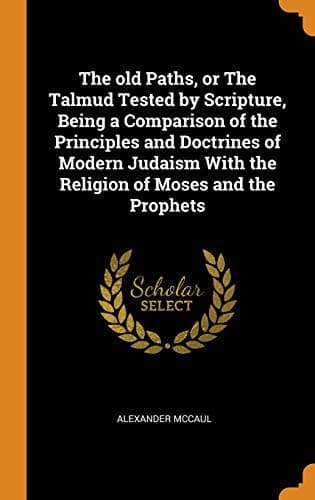
The old paths, or the Talmud tested by Scripture: Being a comparison of the principles and doctrines of modern Judaism with the religion of Moses and the prophetsMcCaul, Alexander
Religion
The old paths, or the Talmud tested by Scripture: Being a comparison of the principles and doctrines of modern Judaism with the religion of Moses and the prophets
McCaul, Alexander
Judaism -- Works to 1900
“And it is necessary for such an one to take the seven commandments on
him in the presence of three learned men, who are qualified to be
Rabbies.” (Hilchoth Melachim, c. viii. 10.) According to the oral law,
then, there are no such persons now existing as “the pious of the
nations of the world.” It is, therefore, idle to talk of the liberality
with which they would be treated, were they forthcoming. Thus the only
appearance of an argument in favour of the Talmud vanishes into thin
air, and mocks our grasp, as soon as we endeavour to lay hold of it.
Those who caught at this phantom of charity, no doubt meant it
sincerely. They thought that the oral law was misrepresented. They were
told that it was charitable, and they therefore nobly came forward in
its defence. If they had known its true principles, they would have
renounced them. Their advocacy went on a false supposition. But now that
we have set forth the true bearings of the case, and given them chapter
and verse to which they may refer, and convince themselves, we call upon
them to do so: and then, as they hate intolerance, to join with us in
protesting against it, even though it should be found in that system,
which hitherto they have believed, on the testimony of others, to be
Divine. At the same time we would seriously ask of them to compare this
system, which has been for more than 1,700 years the religion of the
majority of the Jewish nation, with the system laid down in the New
Testament, and to decide which is most agreeable to the character of
God, as revealed in the law and the prophets, and most beneficial to the
world. The oral law says, that God has commanded the heathen to be left
for 2,700 years without the means of instruction, and that when the days
of Israel’s prosperity come, the nations are to be converted by force;
but that even then, they will not be raised to the rank of brethren, but
only be sojourning proselytes. The oral law looks forward to no reunion
of all the sons of Adam into one happy family. The New Testament has, on
the contrary, commanded its disciples to afford the means of instruction
“to every creature.” It speaks to us Gentiles, who were once regarded as
poor outcasts, in the language of love, and says, “Now, therefore, ye
are no more strangers and foreigners, but fellow-citizens with the
saints, and of the household of God.” (Ephes. ii. 19.) It takes nothing
from you. It asserts your privileges as the peculiar people of God; but
it reveals that great, and to us, most comfortable truth, “That the
Gentiles should be follow-heirs, and of the same body;” and it promises
a happy time, when there shall be one fold and one Shepherd. It does,
indeed, tell us not to forget what we once were, “aliens from the
commonwealth of Israel, and strangers from the covenant of promise,
having no hope, and without God in the world.” (Eph. ii. 12.) It reminds
us that the olive-tree is Jewish, and that you are the natural branches,
and warns us against all boasting. (Rom.
Public-domain text, read in full here on John Shaqi.
Reviews
Reviews
No reviews yet
Be the first to share your thoughts on this work.
Elsewhere in the archive
Join the Discussion
Join the discussion
Sign in to leave a comment or review.
Sign InorCreate an account