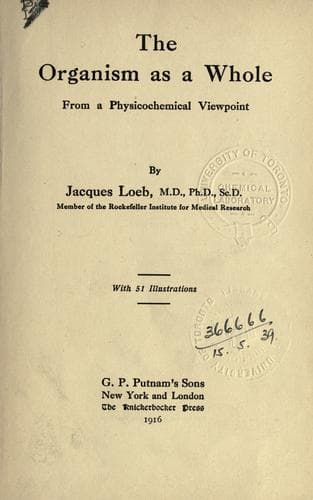
The Organism as a Whole, from a Physicochemical ViewpointLoeb, Jacques
Science
The Organism as a Whole, from a Physicochemical Viewpoint
Loeb, Jacques
Biology; Life (Biology); Mendel's law
The substances and agencies which cause cytolysis and hence, if their
action is restricted to the surface of the egg, will induce development
are, besides the fatty acids: (1) saponin or solanin or bile salts;
(2) the solvents of lipoids, benzol, toluol, amylene, chloroform,
aldehyde, ether, alcohols, etc.; (3) bases; (4) hypertonic or hypotonic
solutions; (5) rise in temperature, and (6) certain salts, _e. g._,
BaCl₂ and SrCl₂ in the case of the egg of _purpuratus_, and according
to R. Lillie, NaI or NaCNS in the egg of _Arbacia_. Whenever we submit
an unfertilized sea-urchin egg to any of these agencies and restrict
the cytolysis to the superficial or cortical layer of the egg (_i. e._,
if we transfer the egg to normal sea water before the cytolytic agent
has had time to diffuse into the main egg) the egg will form a membrane
and behave as if the membrane formation had been called forth by a
fatty acid, with this difference only, that the various agencies are
not all equally harmless for the egg.[88]
[88] The reader is referred for details to the writer’s book on the
subject.
If the idea was correct that the change underlying membrane formation
was essentially a cytolysis of the cortical layer of the egg, it was
to be expected (from the data contained in Chapter III) that the
blood serum or the cell extracts of foreign species would also cause
membrane formation and thus induce the development of the unfertilized
egg, while serum of animals of the same species or genus would have no
such effects. This was found to be correct. In 1907 the writer showed
that the blood serum of a Gephyrean worm, _Dendrostoma_, was able to
cause membrane formation in the egg of the sea urchin. When added in a
dilution of 1 c.c. of serum to 500 or 1000 c.c. of sea water to eggs of
_purpuratus_ a certain number formed fertilization membranes. It was
found later that the serum and tissue extracts of a large number of
animals, especially of mammals (rabbit, pig, ox, etc.), had the same
effect, though it was necessary to use higher concentrations, one-half
sea water and one-half isotonic blood serum. The eggs of every female
sea urchin, however, did not give the reaction and not all the eggs
even of sensitive females formed membranes. The writer found, however,
that it was possible to increase the susceptibility of the eggs against
foreign blood serum by putting them into a 3/8 m solution of SrCl₂ for
from five to ten minutes (or possibly a little longer) before exposing
them to the foreign blood serum. BaCl₂ acts similarly. The fact that
SrCl₂ alone can cause membrane formation in unfertilized eggs if they
are left long enough in the solution suggests that the sensitizing
effect of the substance consists in a modification of the cortical
layer similar to that underlying membrane formation; and that the
subliminal effect of a short treatment with SrCl₂ and the subliminal
effect of the foreign serum when combined suffice to bring about the
membrane formation.
Public-domain text, read in full here on John Shaqi.
Reviews
Reviews
No reviews yet
Be the first to share your thoughts on this work.
Join the Discussion
Join the discussion
Sign in to leave a comment or review.
Sign InorCreate an account