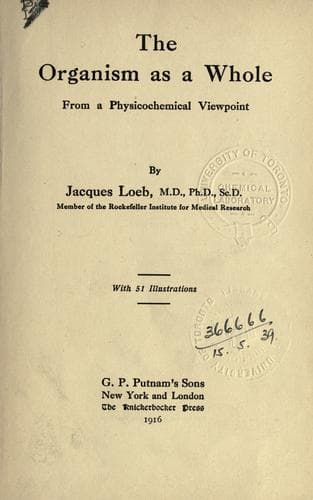
The Organism as a Whole, from a Physicochemical ViewpointLoeb, Jacques
Science
The Organism as a Whole, from a Physicochemical Viewpoint
Loeb, Jacques
Biology; Life (Biology); Mendel's law
3. The action of acids in the mechanism of artificial parthenogenesis
provides some interesting physiological problems. When unfertilized
sea-urchin eggs are left _in_ sea water containing any of the lower
fatty acids up to capronic, the eggs will form no membranes, while
_in_ such sea water, and they will show no outer signs of cytolysis
(swelling). When, however, the eggs are left in sea water containing
any of the fatty acids from heptylic upward the eggs will form
membranes while _in_ the acid sea water and soon afterward will
cytolyze completely and swell enormously. In solutions of the mineral
acids no membranes are formed and none are formed as a rule when the
eggs are transferred back to sea water. When both a mineral and a lower
fatty acid, _e. g._, butyric, are added to sea water the mineral acid
acts as if it were not present, _i. e._, the eggs form membranes when
transferred back to sea water if the concentration of the butyric acid
is high enough. All these data are comprehensible if we assume that
only that part of the acid causes membrane formation which is lipoid
soluble, while the water soluble part is not involved in the process
of membrane formation; and that the cytolysis or swelling of the whole
egg can only take place in the higher fatty acids (heptylic or above)
which are little soluble in water and very soluble in lipoids, while
the lower fatty acids, whose water solubility is comparatively high,
can only bring about a cytolysis and swelling in the cortical layer but
not in the rest of the egg. This makes it appear as though the part
undergoing an alteration in membrane formation was a lipoid; and this
would harmonize with the assumption that the specific membrane-inducing
substance in the spermatozoön is not soluble in water, but soluble in
fat.
4. These and other observations led the writer to the view that the
essential process which causes development might be an alteration
of the surface of the egg, in all probability an alteration of the
superficial layer probably of the nature of a superficial cytolysis.
The question remains: What could be the physicochemical nature of
this cytolysis? The writer had suggested in former papers that in the
cytolysis underlying membrane formation lipoids were dissolved, and he
supposed that the substance to be dissolved might be a calcium-lipoid
compound which might form a continuous layer under the surface of the
egg.[90] v. Knaffl, working on the cytolysis of eggs in the writer’s
laboratory, gave the following idea of the process:
Public-domain text, read in full here on John Shaqi.
Reviews
Reviews
No reviews yet
Be the first to share your thoughts on this work.
Elsewhere in the archive
Join the Discussion
Join the discussion
Sign in to leave a comment or review.
Sign InorCreate an account