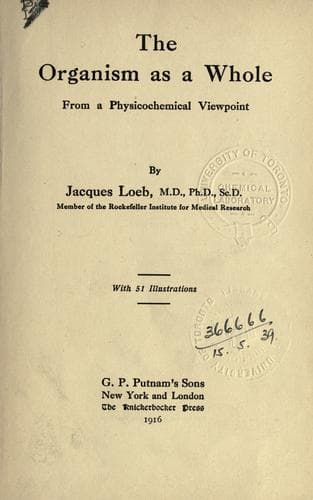
The Organism as a Whole, from a Physicochemical ViewpointLoeb, Jacques
Science
The Organism as a Whole, from a Physicochemical Viewpoint
Loeb, Jacques
Biology; Life (Biology); Mendel's law
It is impossible to state at present whether the fertilization
membrane is preformed in the fertilized egg and merely lifted off from
the egg or whether its formation is due to the hardening of a colloidal
substance separated from the emulsion (or excreted) and hardened in
touch with sea water. But we can be sure of one thing, namely, that
the liquid between egg and membrane contains some colloidal substance
which determines the tension and spherical shape of the membrane. The
membrane is obviously permeable not only to water but also to dissolved
crystalloids, while it is impermeable to colloids. When we add some
colloidal solution (_e. g._, white of egg, blood serum, or tannic
acid) to the sea water containing fertilized eggs of _purpuratus_, the
membrane collapses and lies close around the egg; while if the eggs are
put back into sea water or a sugar solution the membrane soon assumes
its spherical shape. This is intelligible on the assumption that in the
process of membrane formation (or in the destruction of the emulsion
in the cortical layer) a colloidal substance goes into solution which
cannot diffuse into the sea water since the membrane is impermeable to
the colloidal particles. The membrane is, however, permeable to the
constituents of sea water or to sugar. Consequently sea water will
diffuse into the space between membrane and egg until the tension of
the membrane equals the osmotic pressure of the colloid dissolved in
the space between egg and the membrane. If we add enough colloid to the
outside solution so that its osmotic pressure is higher than that of
the colloidal solution inside the membrane the latter will collapse.
It should also be stated that the unfertilized eggs of many marine
animals are surrounded by a jelly (chorion) which is dissolved when
the egg is fertilized.[93] The writer has shown that the same chemical
substances which will induce membrane formation and artificial
parthenogenesis will as a rule also cause a swelling and liquefaction
of the chorion.
[93] It has been stated by several writers that the eggs of the sea
urchin can no longer form the fertilization membrane when the jelly
surrounding the egg is dissolved. The writer has found that if the
jelly surrounding the eggs of _Strongylocentrotus purpuratus_ is
dissolved by acid the eggs still form a fertilization membrane upon the
entrance of a spermatozoön.
We have devoted so much space to the mechanism of membrane formation
since it is likely to give a clearer insight into the physicochemical
nature of physiological processes than the phenomena of muscular
stimulation and contraction or nerve stimulation, upon which the
majority of physiologists base their conclusions concerning the
mechanism of life phenomena.
Public-domain text, read in full here on John Shaqi.
Reviews
Reviews
No reviews yet
Be the first to share your thoughts on this work.
Elsewhere in the archive
Join the Discussion
Join the discussion
Sign in to leave a comment or review.
Sign InorCreate an account