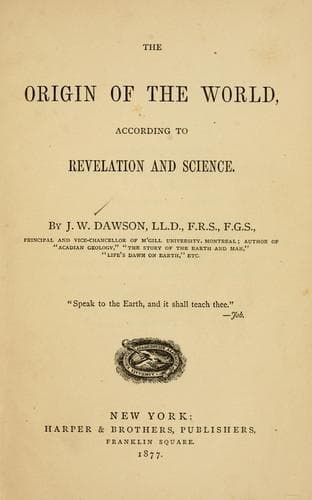
The Origin of the World According to Revelation and ScienceDawson, John William, Sir
Religion
The Origin of the World According to Revelation and Science
Dawson, John William, Sir
Bible and science; Religion and science
"Knowest thou the ordinances of the heavens?
Canst thou establish a dominion even over the earth?"
--Job xxxviii., 33.
The later books give us such views as the following:
"He hath established them [the heavens] for ever and ever;
He hath made a decree which shall not pass."
--Psa. cxlviii., 6.
"Thou art forever, O Jehovah, thy word is established
in the heavens;
Thou hast established the earth, and it abideth;
They continue this day according to thine ordinances,
for all are thy servants."
--Psa. cxix., 90.
"When he established the clouds above;
When he strengthened the fountains of the deep;
When he gave to the sea his decree,
That the waters should not pass his commandment;
When he appointed the foundations of the earth."
--Prov. viii., 28.
Many similar instances will be found in succeeding pages; and in the
mean time we may turn to the idea of recurring cycles, which forms the
starting-point of the reasonings of Solomon on the current of human
affairs, in the book of Ecclesiastes: "One generation passeth away,
and another generation cometh; but the earth abideth for the ages. The
sun ariseth, and the sun goeth down, and hasteneth to its place whence
it arose. The wind goeth toward the south, and turneth unto the north.
It whirleth about continually, and returneth again according to its
circuits. All the rivers run into the sea, yet the sea doth not
overflow; unto the place whence the rivers came, thither they return
again." I might fill pages with quotations more or less illustrative
of the statement in proof of which the above texts are cited; but
enough has been given to show that the doctrine of the Bible is not
that of fortuitous occurrence, or of materialism, or of pantheism, or
of arbitrary supernaturalism, but of invariable natural law
representing the decree of a wise and unchanging Creator. It is a
common but groundless and shallow charge against the Bible that it
teaches an "arbitrary supernaturalism." What it does teach is that
all nature is regulated by the laws of God, which like himself are
unchanging, but which are so complex in their relations and
adjustments that they allow of infinite variety, and do not exclude
even miraculous intervention, or what appears to our limited
intelligence as such. In opposition to this, it is true, some
physicists have held that natural law is a fatal necessity.[19] If
they mean by this a merely hypothetical necessity that certain effects
must follow if certain laws act, this is in accordance with the
Biblical view, for nothing can resist the will of God. But if they
mean an absolute necessity that these laws can not be suspended or
counteracted by higher laws, or by the will of the Creator, they
assert what is not only contrary to Scripture, but absurd, for "blind
metaphysical necessity, which is the same always and everywhere, could
produce no variety of things."[20] It could lead merely to a dead and
inert equilibrium.
Public-domain text, read in full here on John Shaqi.
Reviews
Reviews
No reviews yet
Be the first to share your thoughts on this work.
Join the Discussion
Join the discussion
Sign in to leave a comment or review.
Sign InorCreate an account