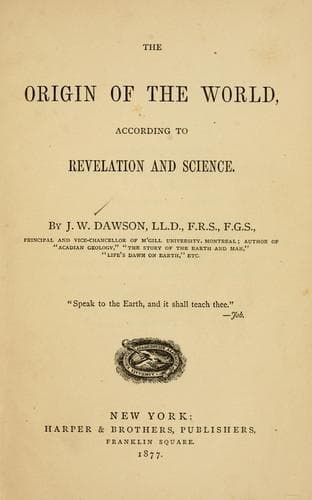
The Origin of the World According to Revelation and ScienceDawson, John William, Sir
Religion
The Origin of the World According to Revelation and Science
Dawson, John William, Sir
Bible and science; Religion and science
It is evident that the writer grasps firmly the essence of the
question as to the beginning of things, and covers the whole ground
which advanced scientific or philosophical speculation can yet
traverse. That the universe must have had a beginning no one now needs
to be told. If any philosophical speculator ever truly held that there
has been an endless succession of phenomena, science has now
completely negatived the idea by showing us the beginning of all
things that we know in the present universe, and by establishing the
strongest probabilities that even its ultimate atoms could not have
been eternal. But the question remains--If there was a beginning, what
existed in that beginning? To this question many partial and imperfect
answers have been given, but our ancient record includes them all.
If any one should say, "In the beginning was nothing." Yes, says
Genesis, there was, it is true, nothing of the present matter and
arrangements of nature. Yet all was present potentially in the will of
the Creator.
"In the beginning were atoms," says another. Yes, says Genesis, but
they were created; and so says modern science, and must say of
ultimate particles determined by weight and measure, and incapable of
modification in their essential properties--"They have the properties
of a manufactured article."[29]
"In the beginning were forces," says yet another. True, says Genesis;
but all forces are one in origin--they represent merely the fiat of
the eternal and self-existent. So says science, that force must in the
ultimate resort be an "expression of Will."[30]
"In the beginning was Elohim," adds our old Semitic authority, and in
him are the absolute and eternal thought and will, the Creator from
whom and by whom and in whom are all things.
Thus the simple familiar words, "In the beginning God created the
heaven and the earth," answer all possible questions as to the origin
of things, and include all under the conception of theism. Let us now
look at these pregnant words more particularly as to their precise
import and significance.
The divine personality expressed by the Hebrew Elohim may be fairly
said to include all that can be claimed for the pantheistic conception
of "dynamis," or universal material power. Lange gives this as
included in the term Elohim, in his discussion of this term in his
book on Genesis. It has been aptly said that if, physically speaking,
the fall of a sparrow produces a gravitative effect that extends
throughout the universe, there can be no reason why it should be
unknown to God. God is thus everywhere, and always. Yet he is
everywhere and always present as a personality knowing and willing.
From his thought and will in the beginning proceeded the universe. By
him it was created.
Public-domain text, read in full here on John Shaqi.
Reviews
Reviews
No reviews yet
Be the first to share your thoughts on this work.
Elsewhere in the archive
Join the Discussion
Join the discussion
Sign in to leave a comment or review.
Sign InorCreate an account