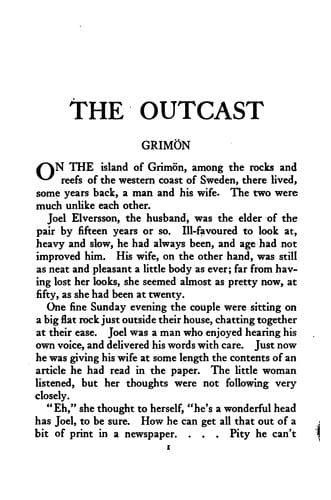
And she herself was very happy; this was surely the greatest thing that
had ever happened in her life. But at the same time she thought to
herself: "Sigrun must be unhappy, indeed, if she weeps for joy at seeing
one so poor as I."
THE VICARAGE
IT WAS an evening in November, when the days were short and the nights
seemed as if they would never end.
All the district round about the vicarage at Algeröd was quiet and
still as in the vicarage itself. The horses had come in from the fields
and were stabled, the cows had been milked, and the fowls had gone to
their roost.
In the brewhouse, or, rather, in the little room beside it, sat Lotta
Hedman that still evening, busy with her calculations. She had the Bible
before her, and pen and ink and paper, and was searching earnestly in
her dear Book of Revelation.
In the kitchen, in the main building, the fire had gone out, and cook
and housemaid sat at the sewing-machine trying to reshape a blouse that
the seamstress had somehow mismanaged; the man was in an adjoining room,
stretched on a bench, waiting for supper-time to come.
The priest was sitting in his study, but not at his writing-table. He
sat in a rocking-chair in one corner of the room. A lamp was close by,
and he was reading the paper. When he raised his eyes, he could see into
the next room, where his wife was sitting on a low stool by the stove.
She sat with her chin in her hands staring into the fire.
Close beside her sat the Bailie, who was staying at the vicarage by
arrangement. He was in poor health, and the Rhånges had been glad to
take him in, since the sum he paid for his keep was a welcome aid to
their scanty resources now they had moved to this poor living up in the
waste lands. He was a man of about fifty, who had never done anything
but please himself all his life, until at last his affairs had been
taken out of his hands, and he himself had been sent up to a place where
he would have no opportunity of wasting the little that remained to him
of money and health.
The Bailie showed traces of a stroke he had had some time before: one
side of his face was drawn awry, and the left eyelid hung down and could
hardly be opened, but, for all that, he was a fine-looking man, of good
bearing. He was a man of the world, had travelled much, and was
intelligent and interesting to talk to.
He had drawn up a chair near the fire, and was telling Sigrun about
foreign lands, that she had never seen and never would see, now that she
sat buried here in a little parsonage in Sweden.
Sigrun was busy with her own thoughts and her restless desires, and let
his words pass idly by. She she could have listened to what he was
saying; it would have perhaps dispelled her weariness and longing if she
could. But it was beyond her power.
Public-domain text, read in full here on John Shaqi.
Reviews
Reviews
No reviews yet
Be the first to share your thoughts on this work.
Join the Discussion
Join the discussion
Sign in to leave a comment or review.
Sign InorCreate an account