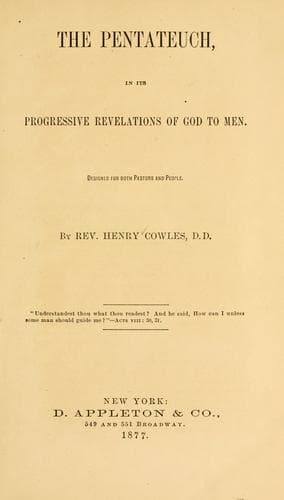
The Pentateuch, in Its Progressive Revelations of God to Men — John Shaqi
The Pentateuch, in Its Progressive Revelations of God to MenCowles, Henry
Religion
The Pentateuch, in Its Progressive Revelations of God to Men
Cowles, Henry
Bible. Pentateuch -- Criticism, interpretation, etc.
(1.) The estimate of the time required for the alluvial deposits along
the banks of rivers, has been extremely various. Lyell, having visited
the delta of the Mississippi river in person, estimated its time-period
of accumulation at one hundred thousand years.[14] But a careful
examination made by gentlemen of the Coast Survey and other United
States officers, reduces this time-period to four thousand and four
hundred years.[15] Again, Mr. Lyell estimates that 220,000 years are
necessary to account for changes now going on upon the coast of Sweden.
Later geologists reduce the time to one-tenth of that estimate. A piece
of pottery was discovered deeply buried under the deposits at the mouth
of the Nile. It was confidently asserted that the deposits could not
have been made during the historic period, until it was proved that
the article in question was of Roman manufacture.[16] Such diversities
suffice to show at least that somebody has blundered. Some of these
high estimates are gratuitously extravagant. All estimates from the
drift deposits, bearing on the antiquity of man, ought in reason to be
made with careful reference to these two modifying considerations:
(a.) That drift deposits may have been, and with the utmost probability
were, much more rapid in the earlier ages than at present. At the close
of the glacial and ice period vast masses of loose matter were ready
to be swept rapidly as drift by river freshets. Any farmer may have
an illustration of this if he will plow his side-hill field, running
his furrows up and down the hill. He will find that the first powerful
shower will bring down far more drift than the fortieth. It would be
very short-sighted in him to take the drift of the tenth year after the
said plowing for his rate of annual deposition and estimate the whole
period from this data. But on this mistaken principle some geologists
have made their time estimates for the drift simply monstrous.
(b.) Human remains and tools may in many ways get far below the
surface of the drift. They may have been buried under it after
its deposition. While the drift lay under water, (soft and pliable
therefore,) flints, arrow-heads, knives, or human bones, may have
sunk in the mire.――――These and similar considerations may demand large
abatement from the time-estimates built upon the amount of drift found
above the remains of man.
Public-domain text, read in full here on John Shaqi.
Reviews
Reviews
No reviews yet
Be the first to share your thoughts on this work.
Join the Discussion
Join the discussion
Sign in to leave a comment or review.
Sign InorCreate an account