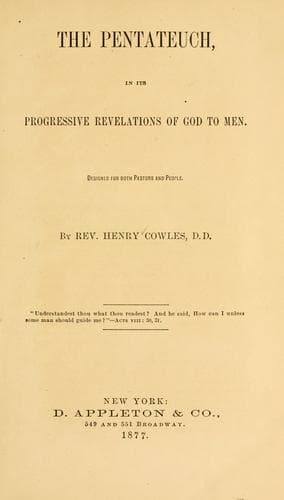
The Pentateuch, in Its Progressive Revelations of God to Men — John Shaqi
The Pentateuch, in Its Progressive Revelations of God to MenCowles, Henry
Religion
The Pentateuch, in Its Progressive Revelations of God to Men
Cowles, Henry
Bible. Pentateuch -- Criticism, interpretation, etc.
In the outset, it can not be assumed reasonably that this stone-age
civilization, apparent in Northern and Western Europe, was _necessarily
universal at that time over all the earth_. It may have been coeval
with the very high civilization of Egypt and even of Babylonia,
Phenicia, Etruria. We must consider that large portions of the world in
those early times were unknown to each other, even as interior Africa
has been unknown to the civilized world almost to this very hour. It
is therefore entirely an open question――Was this stone-age civilization
pre-Adamic? Was it anterior to Noah; or shall its place in the ages be
found contemporaneous with the early civilized nations of known history?
It is important here to premise yet further that the earth’s surface
has at no very remote period experienced considerable elevations and
depressions and changes of temperature. Especially there are proofs
of an extraordinary period of glaciers and icebergs, by means of
which huge bowlders have been transported from their ancient beds
and scattered afar, and vast masses of debris, rocks ground down and
pulverized, mixed with sand, gravel, and small stones, have been heaped
up along the line of the glaciers and spread over their track. It is
not easy to conceive the full measure of _utility_ resulting from this
great ice-flood and glacier movement, in grinding the surface of the
rocky strata and mixing this finely pulverized matter with decomposed
vegetable elements to prepare soil for our earth’s surface.
The opinion is becoming general that man was not placed upon the earth
until _after_ this glacial and ice-bound age. He could not have lived
here then: certainly not in portions reached by glacial action and ice
floods; the earth was not ready for him till afterwards. No decisive
traces of his presence at an earlier period have been found. Such
traces appear shortly after.
The problem of the _time_ of man’s first appearance upon the earth
is for the most part one _of estimates_; and these estimates in the
department of geology are comprised, at least chiefly, under these five
heads:
(1.) The time required for the _alluvial deposits_ underneath which his
remains or implements have been found.
(2.) The time required for the _growth of the peat_ under which we find
man or his works.
(3.) The time required for the succession of forest growths since his
first appearance.
(4.) The age of the animal races, extinct or living, whose remains are
found associated with his.
(5.) We have next and last another source of testimony which is mainly
free from the uncertainties of estimate, viz. the question of
commercial relations between the barbarous stone-age, bronze-age, or
iron-age tribes, and the civilized nations of the early historic ages.
The estimates on these several points demand distinct consideration.
Public-domain text, read in full here on John Shaqi.
Reviews
Reviews
No reviews yet
Be the first to share your thoughts on this work.
Join the Discussion
Join the discussion
Sign in to leave a comment or review.
Sign InorCreate an account