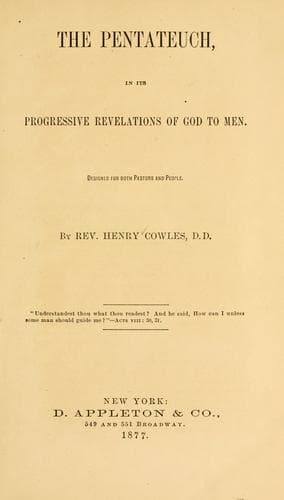
The Pentateuch, in Its Progressive Revelations of God to MenCowles, Henry
Religion
The Pentateuch, in Its Progressive Revelations of God to Men
Cowles, Henry
Bible. Pentateuch -- Criticism, interpretation, etc.
The assumption that Stephen was mistaken is to be rejected; partly
because it was vital to the purposes of his speech that his historic
points should be accurately made――at least in harmony with current
Jewish opinion――to say nothing of the further fact that he is before
us as one “filled with the Holy Ghost” and specially inspired; partly
because the history represents Terah as sympathizing fully in the
spirit of the removal from Ur to Canaan, and apparently prevented
from going only by the infirmities of age.――――The choice seems,
therefore, to lie between the first named explanation and the last.
The first――making the passage (Gen. 11: 26) mean only that Terah lived
70 years before the birth of his eldest, but became the father of
three sons――leaving us at liberty to fix Abraham’s birth at his 130th
year――is a possible construction, but is rendered somewhat improbable
by Abram’s question (Gen. 17: 17) “Shall a son be born to him that is
100 years old”? How could he have thought this strange if in fact he
himself had been born when his father was 130?――――There may be an error
in the number of years of Terah’s life; the Samaritan text may be right
in making it 145. This is below the average age of his fathers; but
in those as in all other days, men were subject to die before they
reached the maximum age of their generation. It would seem that he set
out from Ur with the reasonable expectation of going to Canaan. Hence
a probability that he died unexpectedly, and at an earlier age than his
fathers. I can express no positive opinion upon this case.
* * * * *
Two other doubtful periods remain to be considered, viz. _The interval
from the creation to the flood; and the interval from the flood to the
call of Abram._ The question upon these two intervals is substantially
the same, so that they may properly be presented together. It hinges
in both cases upon the authority of the texts――viz. for the former
interval, Gen. 5: 3–32; and for the latter, Gen. 11: 10–26.――――In
form these tables are not chronological but genealogical. They do
not reckon from any given era, as if (_e. g._) to show the interval
from the creation to the flood, but give the age of each member of
the genealogical line when his son of the same line was born. It is
therefore by adding together these measured portions of each man’s life,
viz. the years he lived before the next member in the line was born,
that we obtain the entire interval.――――The tables give three facts
as to each man’s life; (a.) how old he was when his son in this line
was born; (b.) how long he lived afterwards; and (c.) the sum total
of his years. If the chain is perfect, with neither missing nor
supernumerary links, and if the numbers of the first class are all
correct, the result must be reliable. But plainly the result will be
changed at once by changing the first set of numbers and the second to
correspond,――without changing the third at all.
Public-domain text, read in full here on John Shaqi.
Reviews
Reviews
No reviews yet
Be the first to share your thoughts on this work.
Elsewhere in the archive
Join the Discussion
Join the discussion
Sign in to leave a comment or review.
Sign InorCreate an account