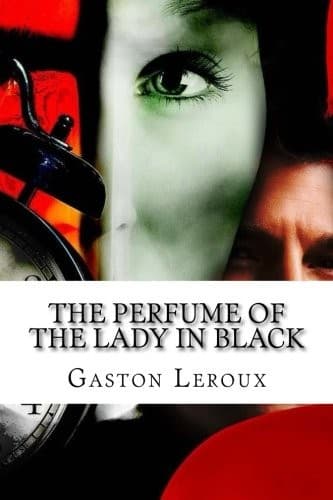
Detective and mystery stories; Rouletabille, Joseph (Fictitious character) -- Fiction
But while she spoke to us in her sweet, clear voice, I stopped looking
at the objects around us to look at the people. Arthur Rance was gazing
at Mme. Darzac, when my eyes fell upon them, and Rouletabille seemed
to be lost in thought, and far, far away from us all. M. Darzac and
M. Stangerson were talking in low tones. The same thought was filling
the minds of each one of these people--both those who kept silence and
those who, if they spoke, were careful to say nothing which could give
a clue to the thoughts. We reached the postern.
“This is what we call the Gardener’s Tower,” said Edith, childishly.
“From this gate one may see all the fort, and all the castle, both
north and south. See!”
And she stretched her arms wide to emphasize her words.
“Every stone has its history. I’ll tell them to you some day, if you
are good.”
“How gay Edith is!” murmured her husband. I thought to myself that she
was the only one who was gay in the party.
We had passed through the postern and found ourselves in another
court. Opposite us was the old donjon. Its appearance was more than
impressive. It was high and square, and it was on account of its shape
that it was known as the Square Tower. And, as this tower occupies
the most important corner of the fortification, it was also known as
the Corner Tower. It was the most extraordinary and the most important
part of this agglomeration of defensive works. The walls were heavier
and higher than those anywhere else, and half way up they were still
sealed with the Roman cement with which Cæsar’s own columns had welded
together the stones.
“That tower yonder, in the opposite corner,” went on Edith, “is the
Tower of Charles the Bold, so called because he was the Duke who
furnished the plans when it became necessary to transform the defenses
of the château, so as to make them resist the attacks of the artillery.
Don’t you think I am very learned? Old Bob has made this tower his
study. It is too bad, for we might have a magnificent dining hall
there. But I have never been able to refuse old Bob anything he wanted.
Old Bob,” she added, with a charming smile, “is my uncle--that is the
name he taught me to call him by when I was a little thing. He is not
here just now. He went to Paris on the five o’clock train, but he
will be back to-morrow. He is going to compare some of the anatomical
specimens which he found at Rochers Rouges with those in the Museum of
Natural History in Paris. Ah--here is an oubliette!”
And she showed us in the centre part of the second court a small
shaft, which she called, romantically, an oubliette, and above which a
eucalyptus tree, with its white blossoms and its leafless limbs, leaned
like a woman over a fountain.
Public-domain text, read in full here on John Shaqi.
Reviews
Reviews
No reviews yet
Be the first to share your thoughts on this work.
Elsewhere in the archive
Join the Discussion
Join the discussion
Sign in to leave a comment or review.
Sign InorCreate an account