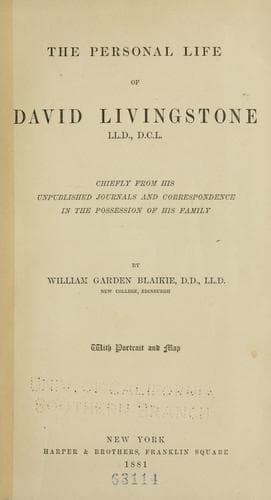
The Personal Life of David Livingstone: Chiefly from his Unpublished Journals and Correspondence in the Possession of His FamilyBlaikie, William Garden
Religion
The Personal Life of David Livingstone: Chiefly from his Unpublished Journals and Correspondence in the Possession of His Family
Blaikie, William Garden
Livingstone, David, 1813-1873
On the 20th November, 1840, Livingstone was ordained a missionary in
Albion Street Chapel, along with the Rev. William Ross, the service
being conducted by the Rev. J.J. Freeman and the Rev. R. Cecil. On the
8th of December he embarked on board the ship "George," under Captain
Donaldson, and proceeded to the Cape, and thence to Algoa Bay. On the
way the ship had to put in at Rio de Janeiro, and he had a glance at
Brazil, with which he was greatly charmed. It was the only glimpse he
ever got of any part of the great continent of America. Writing to the
Rev. G.D. Watt, with whom he had become intimate in London, and who was
preparing to go as a missionary to India, he says:
"It is certainly the finest place I ever saw; everything
delighted me except man.... We lived in the home of an
American Episcopal Methodist minister--the only Protestant
missionary in Brazil.... Tracts and Bibles are circulated,
and some effects might be expected, were a most injurious
influence not exerted by European visitors. These alike
disgrace themselves and the religion they profess by
drunkenness. All other vices are common in Rio. When will the
rays of Divine light dispel the darkness in this beautiful
empire? The climate is delightful. I wonder if disabled
Indian missionaries could not make themselves useful there."
During the voyage his chief friend was the captain of the ship. "He was
very obliging to me," says Livingstone, "and gave me all the information
respecting the use of the quadrant in his power, frequently sitting up
till twelve o'clock at night for the purpose of taking lunar
observations with me." Thus another qualification was acquired for his
very peculiar life-work. Sundays were not times of refreshing, at least
not beyond his closet. "The captain rigged out the church on Sundays,
and we had service; but I being a poor preacher, and the chaplain
addressing them all as Christians already, no moral influence was
exerted, and even had there been on Sabbath, it would have been
neutralized by the week-day conduct. In fact, no good was done." Neither
at Rio, nor on board ship, nor anywhere, could good be done without the
element of personal character. This was Livingstone's strong conviction
to the end of his life.
In his first letter to the Directors of the London Missionary Society he
tells them that he had spent most of his time at sea in the study of
theology, and that he was deeply grieved to say that he knew of no
spiritual good having been done in the case of any one on board the
ship. His characteristic honesty thus showed itself in his very
first dispatch.
Public-domain text, read in full here on John Shaqi.
Reviews
Reviews
No reviews yet
Be the first to share your thoughts on this work.
Join the Discussion
Join the discussion
Sign in to leave a comment or review.
Sign InorCreate an account