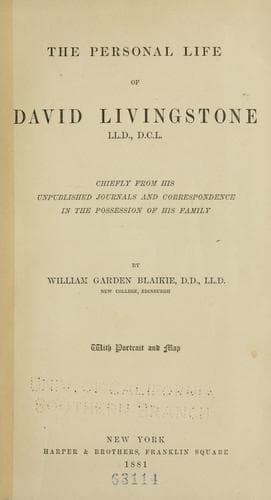
The Personal Life of David Livingstone: Chiefly from his Unpublished Journals and Correspondence in the Possession of His FamilyBlaikie, William Garden
Religion
The Personal Life of David Livingstone: Chiefly from his Unpublished Journals and Correspondence in the Possession of His Family
Blaikie, William Garden
Livingstone, David, 1813-1873
"The scenery was very fine. The white sand in some places
near the beach drifted up in large wreaths exactly like snow.
One might imagine himself in Scotland were there not a hot
sun overhead. The woods present an aspect of strangeness, for
everywhere the eye meets the foreign-looking tree from which
the bitter aloes is extracted, popping up its head among the
mimosa bushes and stunted acacias. Beautiful humming-birds
fly about in great numbers, sucking the nectar from the
flowers, which are in great abundance and very beautiful. I
was much pleased with my visit to Hankey.... The state of the
people presents so many features of interest, that one may
talk about it and convey some idea of what the Gospel has
done. The full extent of the benefit received can, however,
be understood only by those who witness it in contrast with
other places that have not been so highly favored. My
expectations have been far exceeded. Everything I witnessed
surpassed my hopes, and if this one station is a fair sample
of the whole, the statements of the missionaries with regard
to their success are far within the mark. The Hottentots of
Hankey appear to be in a state similar to that of our
forefathers in the days immediately preceding the times of
the Covenanters. They have a prayer-meeting every morning at
four o'clock, _and well attended_. They began it during a
visitation of measles among them, and liked it so much that
they still continue."
He goes on to say that as the natives had no clocks or watches, mistakes
sometimes occurred about ringing the bell for this meeting, and
sometimes the people found themselves assembled at twelve or one o'clock
instead of four. The welcome to the missionaries (their own missionary
was returning from the Cape with Livingstone) was wonderful. Muskets
were fired at their approach, then big guns; and then men, women, and
children rushed at the top of their speed to shake hands and welcome
them. The missionary had lost a little boy, and out of respect each of
the people had something black on his head. Both public worship and
family worship were very interesting, the singing of hymns being very
beautiful. The bearing of these Christianized Hottentots was in complete
contrast to that of a Dutch family whom he visited as a medical man one
Sunday. There was no Sunday; the man's wife and daughters were dancing
before the house, while a black played the fiddle.
Public-domain text, read in full here on John Shaqi.
Reviews
Reviews
No reviews yet
Be the first to share your thoughts on this work.
Join the Discussion
Join the discussion
Sign in to leave a comment or review.
Sign InorCreate an account