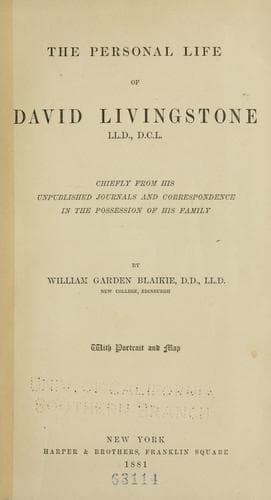
The Personal Life of David Livingstone: Chiefly from his Unpublished Journals and Correspondence in the Possession of His FamilyBlaikie, William Garden
Religion
The Personal Life of David Livingstone: Chiefly from his Unpublished Journals and Correspondence in the Possession of His Family
Blaikie, William Garden
Livingstone, David, 1813-1873
Accordingly, in company with a brother missionary from Kuruman, a
journey of seven hundred miles was performed before the end of the year,
leading chiefly to two results: in the first place, a strong
confirmation of his views on the subject of native agency; and in the
second place, the selection of a station, two hundred and fifty miles
north of Kuruman, as the most suitable for missionary operations. Seven
hundred miles traveled over _more Africano_ seemed to indicate a vast
territory; but on looking at it on the map, it was a mere speck on the
continent of heathenism. How was that continent ever to be evangelized?
He could think of no method except an extensive method of native agency.
And the natives, when qualified, were admirably qualified. Their warm,
affectionate manner of dealing with their fellow-men, their ability to
present the truth to their minds freed from the strangeness of which
foreigners could not divest it, and the eminent success of those
employed by the brethren of Griqua Town, were greatly in their favor.
Two natives had likewise been employed recently by the Kuruman Mission,
and these had been highly efficient and successful. If the Directors
would allow him to employ more of these, conversions would increase in a
compound ratio, and regions not yet explored by Europeans would soon be
supplied with the bread of life.
In regard to the spot selected for a mission, there were many
considerations in its favor. In the immediate neighborhood of Kuruman
the chiefs hated the gospel, because it deprived them of their
supernumerary wives. In the region farther north, this feeling had not
yet established itself; on the contrary, there was an impression
favorable to Europeans, and a desire for their alliance. These Bechuana
tribes had suffered much from the marauding invasions of their
neighbors; and recently, the most terrible marauder of the country,
Mosilikatse, after being driven westward by the Dutch Boers, had taken
up his abode on the banks of a central lake, and resumed his raids,
which were keeping the whole country in alarm. The more peaceful tribes
had heard of the value of the white man, and of the weapons by which a
mere handful of whites had repulsed hordes of marauders. They were
therefore disposed to welcome the stranger, although this state of
feeling could not be relied on as sure to continue, for Griqua hunters
and individuals from tribes hostile to the gospel were moving northward,
and not only circulating rumors unfavorable to missionaries, but by
their wicked lives introducing diseases previously unknown. If these
regions, therefore, were to be taken possession of by the gospel, no
time was to be lost. For himself, Livingstone had no hesitation in going
to reside in the midst of these savages, hundreds of miles away from
civilization, not merely for a visit, but, if necessary, for the whole
of his life.
Public-domain text, read in full here on John Shaqi.
Reviews
Reviews
No reviews yet
Be the first to share your thoughts on this work.
Join the Discussion
Join the discussion
Sign in to leave a comment or review.
Sign InorCreate an account