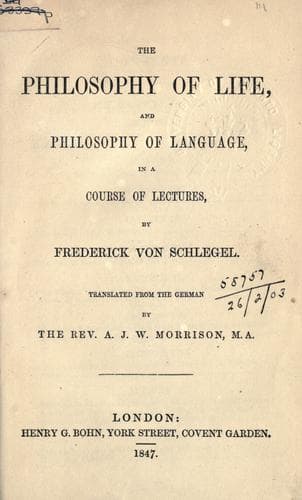
The philosophy of life, and philosophy of language, in a course of lecturesSchlegel, Friedrich von
Philosophy
The philosophy of life, and philosophy of language, in a course of lectures
Schlegel, Friedrich von
Language and languages -- Philosophy; Life; Philosophy
Another line of thought will, perhaps, lead us more directly and nearer
to the end we have in view. The external influence of women on the whole
human community is, for the most part (for here, too, there are great
and memorable exceptions) confined to a narrow sphere of the immediate
duties of the affections, or to similar relations in the wider social
circle. So, too, is it inwardly as regards the consciousness. All the
faculties of women and their several manifestations lie, if I may so
express myself, close together, and, as it were, in a friendly circle
around the loving soul, as their common center. With regard, then, to
the comparison of the two sexes and their mental differences, I would
venture to observe, that on the one side it seems to me that a certain
harmonious fullness of the consciousness is the preponderating
character; and, on the other, its eccentric evolution. Not that I mean
that in the sex which is pre-eminently called to outward activity, the
mind loses its grand center in the inner life, or, comet-like, delights
to wander in vast, irregular orbits, as is, indeed, commonly enough
asserted. My meaning is, simply, that the masculine mind will ever dare,
as, indeed, it ought, to move in wider circles than the feminine. The
extremes of the consciousness, if the expression be allowable--the
farthest poles both of reason and fancy--are, so to speak, the property
of the more active sex; while the harmonious union and contact of both
in the soul belong to the more sensitive. All such general and
characteristic sketches, however, must always be most imperfect. Still I
believe it may be safely and truly said, that, with highly-favored
dispositions and noble natures (and these must be always supposed and
taken for the foundation of such general remarks), the gain to be
derived from this intellectual community and influence, in which one
individual consciousness completes the other, must be sought in the one
sex in a greater development of mind and elevation of soul, and in the
other in a more harmonious adjustment and softening of the mental
powers, and in a far more sensitive excitement of the soul’s
susceptibilities. But in this most intimate of unions, when regarded as
divinely blessed, and when in reality it appears to be so, then on
either side both mind and soul are, as it were, twice combined and
joined together in closest association, and, if we may say so, even
married and wedded together. Consequently, while external life derives
from marriage its moral foundation and origin, the internal life of man
is, as it were, mentally renewed by it, or fructified afresh and
redoubled.
LECTURE III.
OF THE SOUL’S SHARE IN KNOWLEDGE; AND OF REVELATION.
Public-domain text, read in full here on John Shaqi.
Reviews
Reviews
No reviews yet
Be the first to share your thoughts on this work.
Join the Discussion
Join the discussion
Sign in to leave a comment or review.
Sign InorCreate an account