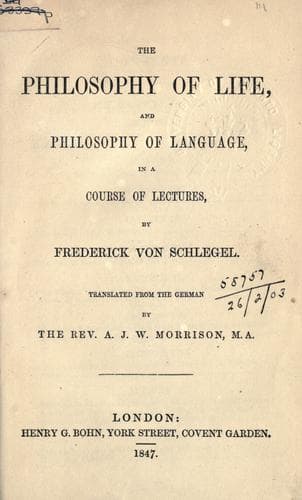
The philosophy of life, and philosophy of language, in a course of lecturesSchlegel, Friedrich von
Philosophy
The philosophy of life, and philosophy of language, in a course of lectures
Schlegel, Friedrich von
Language and languages -- Philosophy; Life; Philosophy
In the first Lecture our attention was directed to the thinking soul as
the center of the whole human consciousness; while in the second, I
attempted fully to set before you, and to delineate, the loving soul as
the true middle point of the moral life. The object of our present
disquisition will be to ascertain the part which the soul takes in the
knowledge to which man is able to attain. The general element, indeed,
which the soul furnishes as its contribution to human knowledge, is not
indeed very difficult to determine; but when we come to details, there
is much that requires to be well weighed and pondered.
Now, the soul furnishes the cognitive mind with language for the
expression of its cognitions; and it is even the distinctive character
of human knowledge, that it depends on language, which not only forms an
essential constituent of it, but is also its indispensable organ.
Language, however, the discursive, but at the same time also the vividly
figurative language of man, is entirely the product of the soul, which
in its production first of all, and pre-eminently, manifests its
fruitful and creative energy. In this wonderful creation the two
constituent faculties of the soul--fancy and reason--play an equal and
co-ordinate part. From the fancy it derives the whole of its figurative
and ornamental portion, and also its melodious rhythm and animated tone.
And, moreover, its inmost fundamental web and the primary natural roots
belong also to man’s original deep feeling of sympathy with outward
nature, and therefore to fancy, unless perhaps some would prefer to
ascribe them at once to the soul itself, as still more profoundly and
intimately akin to nature. To the reason, on the other hand, language
owes its logical order, and its grammatical forms and laws of
construction. Which part is the more important, or more highly to be
esteemed, is a question whose solution will vary according to the point
of view which in any case may be adopted as fundamental, or to the
different relations under which the whole shall be considered. Both
elements, however, are equally essential and indispensable. In all the
instances already considered of the reciprocal relation of reason and
fancy we found almost invariably a decided preponderance of one or the
other; but neither there nor elsewhere will reason and fancy be found
combining in such harmonious proportions, or working so thoroughly
together, or contributing so equally to the common product, as in the
wonderful production of language, and in language itself. And this is
the case, not only with language in general, but also with all its
species and noblest applications. Now this dependence of the cognitive
mind on its organ of language, discursive indeed, but yet almost always
figurative--this close and intimate connection between man’s knowledge
and his speech--is even the characteristic mark of human intelligence.
But the fault of most of the mere speculative thinkers lies even in
Public-domain text, read in full here on John Shaqi.
Reviews
Reviews
No reviews yet
Be the first to share your thoughts on this work.
Join the Discussion
Join the discussion
Sign in to leave a comment or review.
Sign InorCreate an account