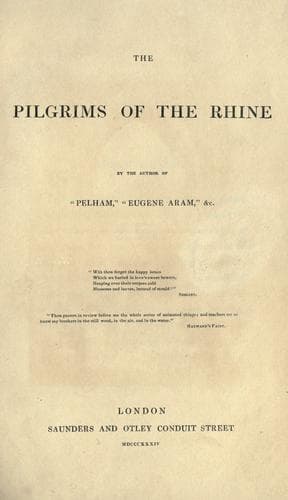
The Pilgrims of the RhineLytton, Edward Bulwer Lytton, Baron
Science
The Pilgrims of the Rhine
Lytton, Edward Bulwer Lytton, Baron
Fairies -- Fiction; Fantasy fiction; Rhine River Valley -- Fiction
They went to see the statue of Erasmus, and the house in which he was
born. Vane had a certain admiration for Erasmus which his companions did
not share; he liked the quiet irony of the sage, and his knowledge of
the world; and, besides, Vane was at that time of life when philosophers
become objects of interest. At first they are teachers; secondly,
friends; and it is only a few who arrive at the third stage, and find
them deceivers. The Dutch are a singular people. Their literature
is neglected, but it has some of the German vein in its strata,--the
patience, the learning, the homely delineation, and even some traces of
the mixture of the humorous and the terrible which form that genius for
the grotesque so especially German--you find this in their legends and
ghost-stories. But in Holland activity destroys, in Germany indolence
nourishes, romance.
They stayed a day or two at Rotterdam, and then proceeded up the Rhine
to Gorcum. The banks were flat and tame, and nothing could be less
impressive of its native majesty than this part of the course of the
great river.
“I never felt before,” whispered Gertrude, tenderly, “how much there
was of consolation in your presence; for here I am at last on the
Rhine,--the blue Rhine, and how disappointed I should be if you were not
by my side!”
“But, my Gertrude, you must wait till we have passed Cologne, before the
_glories_ of the Rhine burst upon you.”
“It reverses life, my child,” said the moralizing Vane; “and the
stream flows through dulness at first, reserving its poetry for our
perseverance.”
“I will not allow your doctrine,” said Trevylyan, as the ambitious
ardour of his native disposition stirred within him. “Life has
always action; it is our own fault if it ever be dull: youth has its
enterprise, manhood its schemes; and even if infirmity creep upon age,
the mind, the mind still triumphs over the mortal clay, and in the quiet
hermitage, among books, and from thoughts, keeps the great wheel within
everlastingly in motion. No, the better class of spirits have always an
antidote to the insipidity of a common career, they have ever energy at
will--”
“And never happiness!” answered Vane, after a pause, as he gazed on the
proud countenance of Trevylyan, with that kind of calm, half-pitying
interest which belonged to a character deeply imbued with the philosophy
of a sad experience acting upon an unimpassioned heart. “And in truth,
Trevylyan, it would please me if I could but teach you the folly of
preferring the exercise of that energy of which you speak to the golden
luxuries of REST. What ambition can ever bring an adequate reward? Not,
surely, the ambition of letters, the desire of intellectual renown!”
Public-domain text, read in full here on John Shaqi.
Reviews
Reviews
No reviews yet
Be the first to share your thoughts on this work.
Join the Discussion
Join the discussion
Sign in to leave a comment or review.
Sign InorCreate an account