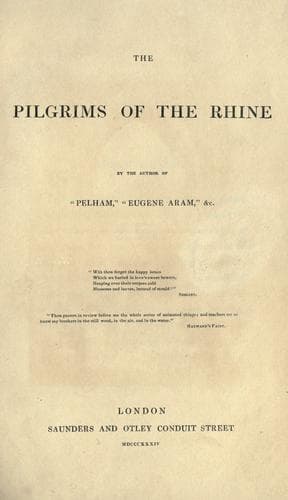
The Pilgrims of the RhineLytton, Edward Bulwer Lytton, Baron
Science
The Pilgrims of the Rhine
Lytton, Edward Bulwer Lytton, Baron
Fairies -- Fiction; Fantasy fiction; Rhine River Valley -- Fiction
“True,” said Trevylyan, quietly; “that dream I have long renounced;
there is nothing palpable in literary fame,--it scarcely perhaps soothes
the vain, it assuredly chafes the proud. In my earlier years I attempted
some works which gained what the world, perhaps rightly, deemed a
sufficient need of reputation; yet it was not sufficient to recompense
myself for the fresh hours I had consumed, for the sacrifices of
pleasure I had made. The subtle aims that had inspired me were not
perceived; the thoughts that had seemed new and beautiful to me fell
flat and lustreless on the soul of others. If I was approved, it
was often for what I condemned myself; and I found that the trite
commonplace and the false wit charmed, while the truth fatigued, and
the enthusiasm revolted. For men of that genius to which I make no
pretension, who have dwelt apart in the obscurity of their own thoughts,
gazing upon stars that shine not for the dull sleepers of the world, it
must be a keen sting to find the product of their labour confounded
with a class, and to be mingled up in men’s judgment with the faults
or merits of a tribe. Every great genius must deem himself original
and alone in his conceptions. It is not enough for him that these
conceptions should be approved as good, unless they are admitted as
inventive, if they mix him with the herd he has shunned, not separate
him in fame as he has been separated in soul. Some Frenchman, the oracle
of his circle, said of the poet of the ‘Phedre,’ ‘Racine and the other
imitators of Corneille;’ and Racine, in his wrath, nearly forswore
tragedy forever. It is in vain to tell the author that the public is the
judge of his works. The author believes himself above the public, or he
would never have written; and,” continued Trevylyan, with enthusiasm,
“he _is_ above them; their fiat may crush his glory, but never his
self-esteem. He stands alone and haughty amidst the wrecks of the temple
he imagined he had raised ‘To THE FUTURE,’ and retaliates neglect with
scorn. But is this, the life of scorn, a pleasurable state of existence?
Is it one to be cherished? Does even the moment of fame counterbalance
the years of mortification? And what is there in literary fame itself
present and palpable to its heir? His work is a pebble thrown into
the deep; the stir lasts for a moment, and the wave closes up, to be
susceptible no more to the same impression. The circle may widen to
other lands and other ages, but around _him_ it is weak and faint. The
trifles of the day, the low politics, the base intrigues, occupy the
tongue, and fill the thought of his contemporaries. He is less known
than a mountebank, or a new dancer; his glory comes not home to him; it
brings no present, no perpetual reward, like the applauses that wait the
actor, or the actor-like murmur of the senate; and this, which vexes,
also lowers him; his noble nature begins to nourish the base vices of
jealousy, and the unwillingness to admire. Goldsmith is forgotten in the
Public-domain text, read in full here on John Shaqi.
Reviews
Reviews
No reviews yet
Be the first to share your thoughts on this work.
Join the Discussion
Join the discussion
Sign in to leave a comment or review.
Sign InorCreate an account