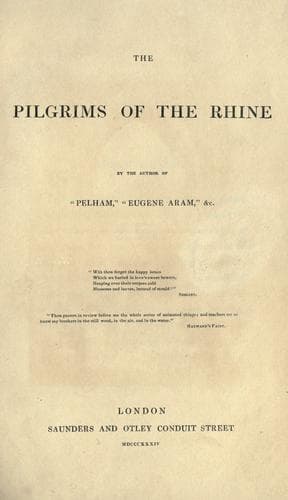
The Pilgrims of the RhineLytton, Edward Bulwer Lytton, Baron
Science
The Pilgrims of the Rhine
Lytton, Edward Bulwer Lytton, Baron
Fairies -- Fiction; Fantasy fiction; Rhine River Valley -- Fiction
“You know,” said that amiable young lady, “that I went to London in
search of a situation. I spent three months of the twelve in going from
house to house, but I could not get a single person to receive me.
The ladies declared that they never saw so old-fashioned a gawkey, and
civilly recommended me to their abigails; the abigails turned me
round with a stare, and then pushed me down to the kitchen and the fat
scullion-maids, who assured me that, ‘in the respectable families they
had the honour to live in, they had never even heard of my name.’ One
young housemaid, just from the country, did indeed receive me with some
sort of civility; but she very soon lost me in the servants’ hall. I
now took refuge with the other sex, as the least uncourteous. I was
fortunate enough to find a young gentleman of remarkable talents, who
welcomed me with open arms. He was full of learning, gentleness, and
honesty. I had only one rival,--Ambition. We both contended for an
absolute empire over him. Whatever Ambition suggested, I damped. Did
Ambition urge him to begin a book, I persuaded him it was not worth
publication. Did he get up, full of knowledge, and instigated by my
rival, to make a speech (for he was in parliament), I shocked him with
the sense of his assurance, I made his voice droop and his accents
falter. At last, with an indignant sigh, my rival left him; he retired
into the country, took orders, and renounced a career he had fondly
hoped would be serviceable to others; but finding I did not suffice for
his happiness, and piqued at his melancholy, I left him before the end
of the year, and he has since taken to drinking!”
The eyes of the Virtues were all turned to Prudence. She was their last
hope. “I am just where I set out,” said that discreet Virtue; “I have
done neither good nor harm. To avoid temptation I went and lived with a
hermit to whom I soon found that I could be of no use beyond warning him
not to overboil his peas and lentils, not to leave his door open when
a storm threatened, and not to fill his pitcher too full at the
neighbouring spring. I am thus the only one of you that never did harm;
but only because I am the only one of you that never had an opportunity
of doing it! In a word,” continued Prudence, thoughtfully,--“in a word,
my friends, circumstances are necessary to the Virtues themselves. Had,
for instance, Economy changed with Generosity, and gone to the poor
lieutenant’s wife, and had I lodged with the Irish squireen instead of
Hospitality, what misfortunes would have been saved to both! Alas! I
perceive we lose all our efficacy when we are misplaced; and _then_,
though in reality Virtues, we operate as Vices. Circumstances must be
favourable to our exertions, and harmonious with our nature; and we
lose our very divinity unless Wisdom direct our footsteps to the home we
should inhabit and the dispositions we should govern.”
The story was ended, and the travellers began to dispute about its
moral. Here let us leave them.
Public-domain text, read in full here on John Shaqi.
Reviews
Reviews
No reviews yet
Be the first to share your thoughts on this work.
Elsewhere in the archive
Join the Discussion
Join the discussion
Sign in to leave a comment or review.
Sign InorCreate an account