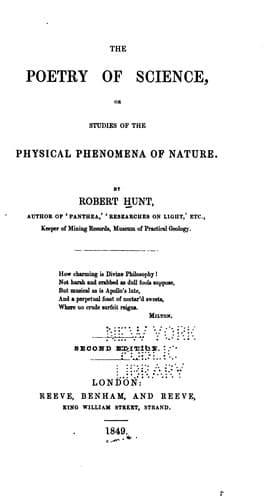
The Poetry of Science; or, Studies of the Physical Phenomena of Nature — John Shaqi
The Poetry of Science; or, Studies of the Physical Phenomena of NatureHunt, Robert
Philosophy
The Poetry of Science; or, Studies of the Physical Phenomena of Nature
Hunt, Robert
Physics; Science
We know that silicon--the metallic base of flint--is capable of
assuming two or more different states; and that sulphur, selenium,
phosphorus, and arsenic, are susceptible of these remarkable changes
in which, without the slightest variation in the chemical character, a
complete change in the physical condition is produced. Copper, iron,
tin, and manganese, are known to exist in at least two states of
physical dissimilarity, and many of the rarer metals exhibit the same
peculiarity.[31] Hence, may we not infer that some of those substances,
which we now term elementary, are but altered conditions of the same
element? The resemblance between many of those bodies strengthens
the supposition. Iridium and platinum,--iron and nickel,--chlorine,
bromine, iodine, and probably fluorine,--are good examples of these
similarities, although these bodies are all distinguished by physical
and chemical differences.
The light-refracting gem, which glistens on the neck of beauty, and is
valued for its transparency, differs only from the rude lump of coke in
its molecular arrangement. Chemistry teaches us that we may, without
producing any disarrangement of the affinities, but by merely setting
up molecular disturbance, effect decided changes, as is strikingly
shown in the colour of iodide of mercury changing from red to yellow
under slight influences of heat, and back again to red by a gentle
mechanical disturbance. By a slight change, merely molecular, iron may
be made to resemble platinum in its physical properties.[32] An iron
wire plunged into nitric acid is attacked by the acid with violence;
but if one extremity of the wire is heated in the flame of a spirit
lamp, such a change of state is produced throughout the entire length
of the wire, that if it be now plunged into nitric acid no effect is
produced upon it. On studying this question, we find good reason for
supposing that bodies which, though physically different, resemble
each other in some of their properties, iodine, bromine, &c., are the
results of different _allotropic_ conditions which have been impressed
upon the ultimate atoms, similar to those observed in the substances
named. This hypothesis appears to be more in accordance with the great
principles which we must conceive guided the labours of an Infinite
Mind, than that which supposes a vast number of individual creations.
It will be seen in the sequel that light, heat, electricity, and
chemical action, have the power of producing yet more striking changes
in the forms of bodies. Is it not probable that, according to the
operations of these agents, either combined or separate, acting over
different spaces of time, and under varying circumstances, in relation
to the molecular forces, all those _allotropic_ states may be produced?
Hence bodies may be discovered, which,--from the imperfections of
science,--resisting our means of analysis, must, for a time, be
regarded as new elements, whereas they are possibly only altered states
Public-domain text, read in full here on John Shaqi.
Reviews
Reviews
No reviews yet
Be the first to share your thoughts on this work.
Join the Discussion
Join the discussion
Sign in to leave a comment or review.
Sign InorCreate an account