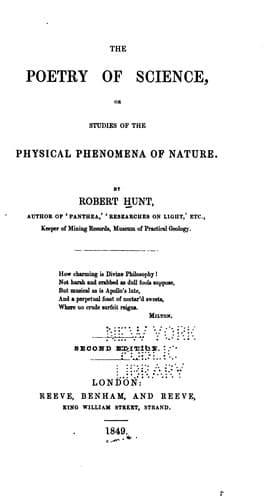
The Poetry of Science; or, Studies of the Physical Phenomena of NatureHunt, Robert
Philosophy
The Poetry of Science; or, Studies of the Physical Phenomena of Nature
Hunt, Robert
Physics; Science
In these instances a large quantity of heat is rendered sensible, as
if it had been squeezed out by the force with which the particles
combined, from interstices, which were filled with, what we may be
allowed to call, an atmosphere of heat. Hence we conclude that, amongst
the influences determining the molecular constitution of a body, heat
performs an important part. All these facts go to prove that the atoms
which form the compound body, whatever may be its character, are
disposed of as so many centres of force, which act by influences of a
peculiar character upon each other. That these influences are dependent
upon known physical forces is certain; but the laws by which the powers
of the ultimate atom are altered remain still unknown.
In the great operations of nature, changes are produced which we cannot
understand, and variations of condition do certainly occur, which may
be regarded as instances of transmutation.
Amongst others, we may adduce the different states in which we
know carbon to exist. We have the diamond with its beautiful
light-refracting property, its hardness and high specific gravity,
capable of being converted into graphite and coke.[29] Charcoal,
graphite, and the diamond, are totally unlike each other, yet we know
they are each composed of the same atoms. Charcoal is a black irregular
substance, light, and readily inflammable; graphite is crystallizable;
but the forms of its crystals cannot be referred to those of the
diamond, and it burns with difficulty. The diamond occurs in the most
regular and beautifully transparent forms; and it can be burned only
at the highest artificial temperatures. We are, however, convinced by
experiment that the brilliant and transparent gem is made up of the
same atoms as those which go to form the dull black mass of charcoal.
From diamonds, as is above stated, coke has been formed by the heat
of the voltaic battery, and recent experiments have proved that the
volatilized carbon constantly passing off from one of the poles of a
sufficiently powerful battery, is deposited in a crystalline powder,
possessing most of the properties, as it regards hardness, &c. of true
diamond dust. What is the mystery of this? We know not. The peculiar
conditions have been the subjects of anxious study; but science has not
yet let in a ray of light upon the mystery. That a different state--it
has been called an _allotropic_ condition--is often induced in the
same class of atoms is certain; and hence the variety of the resulting
compounds. To continue our illustrations with carbon--may not its
combinations, in uniform proportions with oxygen and hydrogen,[30] owe
their differences to some allotropic change in the ultimate atoms of
this element.
Public-domain text, read in full here on John Shaqi.
Reviews
Reviews
No reviews yet
Be the first to share your thoughts on this work.
Join the Discussion
Join the discussion
Sign in to leave a comment or review.
Sign InorCreate an account