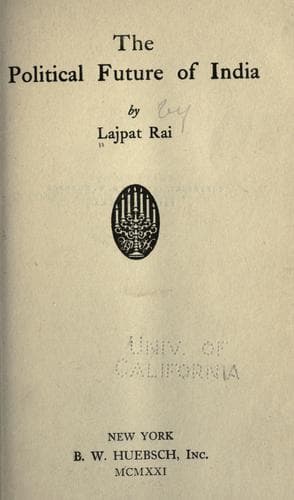
India -- History -- British occupation, 1765-1947; India -- Politics and government -- 1765-1947
little for the submerged classes, the poor ryot and the ill-paid sweated
laborer, but their efforts were of no consequence. They have failed and
their failure is writ large on the face of the ryot. We are not sanguine
that the politically minded classes when they get power will immediately
rehabilitate the ryot and give him his due. We have no hope of that
kind. Yet we unhesitatingly support the demand of the politically minded
classes for a responsible government in India. In our judgment, that is
the only way to raise the masses to a consciousness of their rights and
responsibilities. The experience of the West tells us that in that way
and in that way alone lies salvation. Political consciousness must
travel from the classes to the masses and the longer the inauguration of
popular Government is delayed, the greater the delay in the awakening of
the ryot and the working man. Absolutism must first give way and
transfer its power to the politically minded classes, then will come the
turn of the masses to demand their rights and compel compliance. We can
see no risk of a greater harm or injury to the masses of India from the
transference of power from the hands of a close bureaucracy of
foreigners into the hands of the educated and propertied oligarchy of
their own countrymen. Even in countries like Great Britain, America and
France it is the educated and the propertied classes who rule. Why then
this hubbub about the impropriety and danger of giving power to the same
classes in India? Why are the representatives of landlordism and
capitalism in the British House of Lords and among the ranks of Imperial
Anglo-Indians so solicitous of the welfare of the Indian masses, when
they have for so long persistently denied justice to the proletariat of
their own country? It is a strange phenomenon to see the champions of
privilege and status, the defenders of capitalism and landlordism, the
advocates of the rights of property, the upholders of caste in Great
Britain, spending so much powder and shot to _protect_ the Indian ryot
from the prospective exploitation of him by the Indian Brahmin and the
Indian Banya[6] (the priest and the capitalist). Let the British Brahmin
and the British Banya first begin by doing justice to the proletariat of
their own country and then it will be time for them to convince the
Indian of their altruism and honesty of purpose in obstructing the
inauguration of responsible government in India in the interests of the
Indian proletariat. In this connection the authors of the Report make
some pertinent observations which deserve to be quoted. After speaking
of "religious animosities and social cleavages" and the duty of
discouraging them the authors say:
Public-domain text, read in full here on John Shaqi.
Reviews
Reviews
No reviews yet
Be the first to share your thoughts on this work.
Elsewhere in the archive
Join the Discussion
Join the discussion
Sign in to leave a comment or review.
Sign InorCreate an account