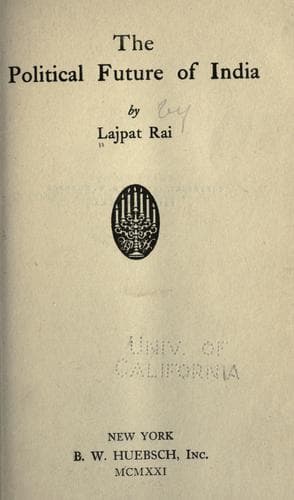
India -- History -- British occupation, 1765-1947; India -- Politics and government -- 1765-1947
From this criticism of the reasons advanced by the authors for a
very mild "advance" (called "gradual") it is with pleasure that we turn
to the brighter side of the picture showing the favorable features of
the situation. The position of the educated Indian is described fairly
and squarely in Paragraph 140.
"The old assumption that the interests of the ryot must be
confided to official hands is strenuously denied by modern
educated Indians. They claim that the European official must by
his lack of imagination and comparative lack of skill in tongues
be gravely handicapped in interpreting the thoughts and desires of
an Asiatic people.... Our educational policy in the past aimed at
satisfying the few, who sought after English education, without
sufficient thought of the consequences which might ensue from not
taking care to extend instruction to the many. We have in fact
created a limited _intelligentsia_, who desire advance; and we
cannot stay their progress entirely until education has been
extended to the masses. It has been made a reproach to the
educated classes that they have followed too exclusively after one
or two pursuits, the law, journalism or school teaching: and that
these are all callings which make men inclined to overrate the
importance of words and phrases. But even if there is substance in
the count, we must take note also how far the past policy of
Government is responsible. We have not succeeded in making
education practical. It is only now, when the war has revealed
the importance of industry, that we have deliberately set about
encouraging Indians to undertake the creation of wealth by
industrial enterprise, and have thereby offered the educated
classes any tangible inducement to overcome their traditional
inclination to look down on practical forms of energy. We must
admit that the educated Indian is a creation peculiarly of our
own; and if we take the credit that is due to us for his strong
points we must admit a similar liability for his weak ones. Let us
note also in justice to him that the progressive Indian appears to
realise the narrow basis of his position and is beginning to
broaden it. In municipal and university work he has taken a useful
and creditable share. We find him organising effort not for
political ends alone, but for various forms of public and social
service. He has come forward and done valuable work in relieving
famine and distress by floods, in keeping order at fairs, in
helping pilgrims, and in promoting co-operative credit. Although
his ventures in the fields of commerce have not been always
fortunate, he is beginning to turn his attention more to the
improvement of agriculture and industry. Above all, he is active
in promoting education and sanitation; and every increase in the
Public-domain text, read in full here on John Shaqi.
Reviews
Reviews
No reviews yet
Be the first to share your thoughts on this work.
Elsewhere in the archive
Join the Discussion
Join the discussion
Sign in to leave a comment or review.
Sign InorCreate an account