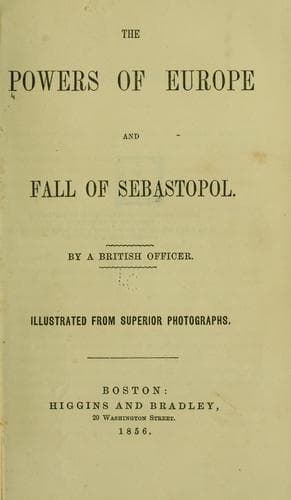
The Powers of Europe and Fall of SebastopolA British officer
History
The Powers of Europe and Fall of Sebastopol
A British officer
Crimean War, 1853-1856; Europe -- History -- 1789-1900
“Vimiero is a village, pleasantly situated in a gentle and quiet
valley, through which flows the small river of Maceria. Beyond, and
to the westward and northward of this village, rises a mountain, of
which the western point reaches the sea; the eastern is separated
by a deep ravine from the height, over which passes the road that
leads from Lourinha and the northward to Vimiero. On this mountain
were posted the chief part of the infantry, with eight pieces of
artillery. General Hill’s brigade was on the right, and Ferguson’s
on the left, having one battalion on the heights, separated from them
by the mountain. Towards the east and south of the town lay a mill,
wholly commanded by the mountain on the west side, and commanding,
also, the surrounding ground to the south and east, on which General
Fane was posted, with his riflemen, and the 50th regiment, and
General Anstruthers’ brigade, with the artillery, which had been
ordered to that position during the night.
“About eight o’clock a picket of the enemy’s horse was first seen on
the heights, toward Lourinha; and, after pushing forward his scouts,
soon appeared in full force, with the evident object of attacking the
British.
“Immediately four brigades, from the mountains on the east, moved
across the ravine to the heights on the road to Lourinha, with three
pieces of cannon. They were formed with their right resting upon
these heights, and their left upon a ravine which separates the
heights from a range at Maceria. On these heights were the Portuguese
troops, and they were supported by General Crawford’s brigade.
“The enemy opened his attack, in strong columns, against the entire
body of troops on this height. On the left they advanced, through
the fire of the riflemen, close up to the 50th regiment, until they
were checked and driven back by that regiment, at the point of the
bayonet. The French infantry, in these divisions, was commanded by
Laborde, Loison, and Kellerman, and the horse by General Margaron.
Their attack was simultaneous, and like that of a man determined to
conquer or to perish. Besides the conflict on the heights, the battle
raged with equal fury on every part of the field. The possession
of the road leading into Vimiero was disputed with persevering
resolution, and especially where a strong body had been posted in the
church-yard, to prevent the enemy forcing an entrance into the town.
Up to this period of the battle the British had received and repulsed
the attacks of the enemy, acting altogether on the defensive. But
now they were attacked in flank by General Ackland’s brigade, as it
advanced to its position on the height to the left, while a brisk
cannonade was kept up by the artillery on those heights.
Public-domain text, read in full here on John Shaqi.
Reviews
Reviews
No reviews yet
Be the first to share your thoughts on this work.
Join the Discussion
Join the discussion
Sign in to leave a comment or review.
Sign InorCreate an account