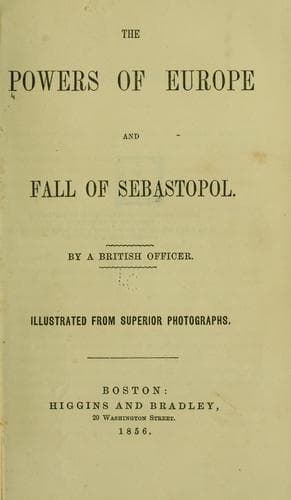
The Powers of Europe and Fall of SebastopolA British officer
History
The Powers of Europe and Fall of Sebastopol
A British officer
Crimean War, 1853-1856; Europe -- History -- 1789-1900
“The brunt of the attack was continued on the brigade of General
Fane, but was bravely repulsed at all points. Once, as the French
retired in confusion, a regiment of light dragoons pursued them with
so little precaution, that they were suddenly set upon by the heavy
cavalry of Margaron, and cut to pieces, with their gallant colonel at
their head.
“No less desperate was the encounter between Kellerman’s column of
reserve and the gallant 43d, in their conflict for the vineyard
adjoining the church. The advanced companies were at first driven
back, with great slaughter; but, again rallying upon the next ranks,
they threw themselves upon the head of a French column in a ravine,
and, charging with the bayonet, put them to the rout. At length the
vigor of the enemy’s attack ceased. They, pressed on all sides by the
British, had lost thirteen cannons and a great number of prisoners;
but were still enabled to retire without confusion, owing to the
protection of their numerous cavalry. An incident occurred in this
battle, so highly characteristic of Highland courage, that I cannot
refrain from quoting it. It is very common for the wounded to cheer
their more fortunate comrades, as they pass on to the attack. A man
named Stewart, the piper of the 71st regiment, was wounded in the
thigh, very severely, at an early period of the action, and refused
to be removed. He sat upon a bank, playing martial airs, during the
remainder of the battle. As a party of his comrades were passing, he
addressed them thus: ‘Weel, my brave lads, I can gang na langer wi’
ye a fightin’, but ye shall na want music.’ On his return home, the
Highland Society voted him a handsome set of pipes, with a flattering
inscription engraved on them.”
The total loss of the French was estimated at three thousand. Soon
after the battle, General Kellerman presented himself, with a
strong body of cavalry, at the outposts, and demanded an interview
with the English general. The result of this interview was the
famous convention of Cintra. By it, it was stipulated that Portugal
should be delivered up to the British army, and the French should
evacuate it, with arms and baggage, but not as prisoners of war;
that the French should be transported, by the British, into their
own country; that the army should carry with it all its artillery,
cavalry, arms, and ammunition, and the soldiers all their private
property. It also provided that the Portuguese who had favored the
French party should not be punished.
Public-domain text, read in full here on John Shaqi.
Reviews
Reviews
No reviews yet
Be the first to share your thoughts on this work.
Join the Discussion
Join the discussion
Sign in to leave a comment or review.
Sign InorCreate an account