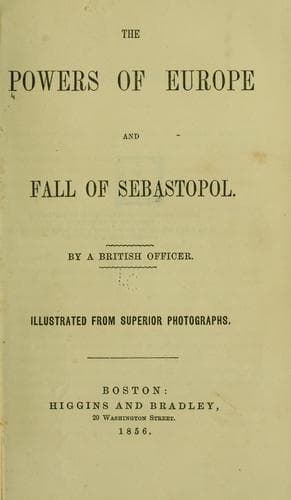
The Powers of Europe and Fall of Sebastopol — John Shaqi
The Powers of Europe and Fall of SebastopolA British officer
History
The Powers of Europe and Fall of Sebastopol
A British officer
Crimean War, 1853-1856; Europe -- History -- 1789-1900
found on their arrival in Spain.” Sir Arthur Wellesley had returned
to Ireland, and the chief command was now given to Sir John Moore.
This general, with the greatest celerity, marched his troops to the
Spanish frontier, by the way of Almeida, having overcome almost
insurmountable obstacles, arising from the state of affairs in Spain.
Sir David Baird, with a force of ten thousand men, landed at Corunna,
and also advanced to the contest; but they soon found that they were
to meet an enemy with whom they were little able to cope.
Napoleon, with that energy so often displayed by him, when the
greatness of the occasion required its exercise, collected, in an
incredibly short space of time, an immense army of two hundred
thousand men, most of them veterans who had partaken of the glories
of Jena, Austerlitz, and Friedland. These were divided by the emperor
into eight parts, called “corps d’armée.” At the head of each of them
was placed one of his old and tried generals,--veterans on whom he
could rely. The very names of Victor, Bessières, Moncey, Lefebre,
Mortier, Ney, St. Cyr, and Junôt, speak volumes for the character of
the army.
These troops were excited to the highest pitch of enthusiasm, by
the emperor’s address, as he passed through Paris, promising that
he would head them in person, to drive the hideous leopard into the
sea. What were the scattered and divided troops of the Spaniards,
to contend with such a force? The grand French army reached
Vittoria almost without an interruption. Blake was in position at
Villarcayo, the Asturians were close at hand, Romana at Bilboa,
and the Estremadurans at Burgos. With more valor than discretion,
Blake made an attack upon Tornosa. The enemy pretended to retreat.
Blake, flushed with his apparent success, pursued them with avidity,
when he suddenly came before twenty-five thousand men, under the
Duke of Dantzic, and was furiously assailed. Blake, after a gallant
defence, was obliged to retreat, in great confusion, upon Bilboa. He
rallied, however, and was again in the field in a few days, fought
a brave action with Villate, and was this time successful. With the
vain-glory of his nation, he next attacked the strong city of Bilboa.
Here, Marshal Victor gained a signal success, Blake losing two of
his generals, and many of his men. Romana, who had joined Blake,
renewed the action, with his veterans. They were made prisoners, but
their brave chief escaped to the mountains. Napoleon himself now left
Bayonne, and directed his course into Spain. Only one day sufficed
for his arrival into Vittoria. At the gates of the city, a large
procession, headed by the civil and military chiefs, met him, and
wished to escort him to a splendid house prepared for his reception;
but they were destined to a disappointment. Napoleon was there, not
for pomp or show, but to direct, with his genius, the march of that
army which he had raised. Jumping from his horse, he entered the
Public-domain text, read in full here on John Shaqi.
Reviews
Reviews
No reviews yet
Be the first to share your thoughts on this work.
Join the Discussion
Join the discussion
Sign in to leave a comment or review.
Sign InorCreate an account