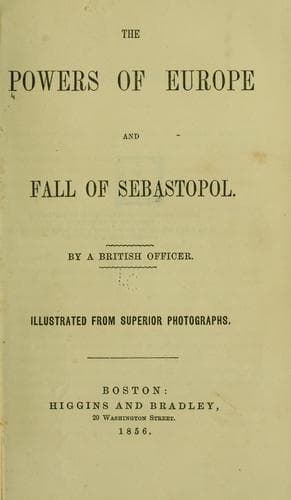
The Powers of Europe and Fall of SebastopolA British officer
History
The Powers of Europe and Fall of Sebastopol
A British officer
Crimean War, 1853-1856; Europe -- History -- 1789-1900
According to the terms of this convention, Junôt, on the 2d of
September, yielded the government of the capital. This suspension of
military rule was followed by a wild scene of anarchy and confusion.
The police disbanded of their own accord, and crime stalked abroad on
every side. Lisbon was illuminated with thousands of little lamps,
at their departure; and such was the state of the public mind, that
Sir John Hope was obliged to make many and severe examples, before he
succeeded in restoring order.
On the 13th, the Duke of Abrantes embarked, with his staff; and
by the 30th of September only the garrisons of Elvas and Almeida
remained in Portugal. This convention was very unpopular in England.
The whole voice of the press was against it; and such was the state
of feeling, that Sir Harry Burrard and Sir Hugh Dalrymple were both
recalled, to present themselves before a court of inquiry, instituted
for the occasion. After a minute investigation, these generals were
declared innocent, but it was judged best to detain them at home.
Having seen Portugal under the control of the English, let us return
to the affairs of Spain. Immediately after the battle of Baylen,
which induced the retreat of Joseph from Madrid, Ferdinand was again
declared king, and the pomp and rejoicings attendant on this event
put an end to all business, except that of intrigue. The French were
everywhere looked upon by the Spanish as a conquered foe, and they
spent their time in the pageant of military triumphs and rejoicings,
as though the enemy had already fled. From this dream of fancied
security Palafox was at length awakened by the appearance of a French
corps, which retook Tudela, and pushed on almost to Saragossa. He
appealed to the governing junta for aid and assistance. Much time was
lost in intrigue and disputes, but at length the army was organized
by appointing La Pena and Llamas to the charge. To supply the place
usually occupied by the commander-in-chief, a board of general
officers was projected, of which Castanos should be chief; but when
some difficulty arose as to who the other members should be, this
plan was deferred, with the remark, that “when the enemy was driven
across the frontier, Castanos would have leisure to take his seat.”
Of the state of the Spanish forces at this time, Napier says, “The
idea of a defeat, the possibility of a failure, had never entered
their minds. The government, evincing neither apprehension, nor
activity, nor foresight, were contented if the people believed the
daily falsehoods propagated relative to the enemy; and the people
were content to be so deceived. The armies were neglected, even to
nakedness; the soldier’s constancy under privations cruelly abused;
disunion, cupidity, incapacity, prevailed in the higher orders;
patriotic ardor was visibly abating among the lower classes; the
rulers were grasping, improvident, and boasting; the enemy powerful,
the people insubordinate. Such were the allies whom the British
Public-domain text, read in full here on John Shaqi.
Reviews
Reviews
No reviews yet
Be the first to share your thoughts on this work.
Join the Discussion
Join the discussion
Sign in to leave a comment or review.
Sign InorCreate an account