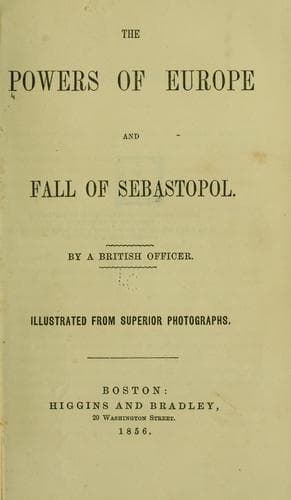
The Powers of Europe and Fall of SebastopolA British officer
History
The Powers of Europe and Fall of Sebastopol
A British officer
Crimean War, 1853-1856; Europe -- History -- 1789-1900
city. No man was safe; none dared assume authority, or even offer
advice. Murder, and lust, and rapine, and cruelty, stalked fearlessly
through the streets. On the morning of the ninth, far away on the
hills to the north-west, appeared a large body of cavalry, like a
dark cloud overhanging the troubled city. At noon, the resistless
emperor sat down before the gates of Madrid, and summoned the city to
surrender. Calmness and quiet reigned in the French camp, but Madrid
was struggling like a wild beast in the toils. Napoleon had no wish
to destroy the capital of his brother’s kingdom, but he was not to be
trifled with. At midnight, a second summons was sent. It was answered
by an equivocal reply, and responded to by the roar of cannon and the
onset of the soldiery. This was an appeal not to be resisted. Madrid
was in no state to stand a siege. At noon, two officers, in Spanish
uniform, and bearing a flag of truce, were observed approaching
the French headquarters. They came to demand a suspension of arms,
necessary, they said, to persuade the people to surrender. It was
granted, and they returned to the city, with Napoleon’s message.
Before six o’clock in the morning, Madrid must surrender, or perish.
Dissensions arose, but the voice of prudence prevailed, and the
capital yielded. Napoleon was wise; he had no wish to goad a people
already incensed to fury. The strictest discipline was maintained,
and a soldier of his own guard was shot for having stolen a watch.
Shops were reöpened, public amusements recommenced, and all was
quiet. In six short weeks every Spanish army was dissipated. From
St. Sebastian to the Asturias, from the Asturias to Talavera, from
Talavera to the gates of Saragossa, all was submission, and beyond
that boundary all was apathy or dread.
An assemblage of the nobles, the clergy, the corporations, and the
tribunals, of Madrid, now waited on Napoleon at his headquarters, and
presented an address, in which they expressed their desire to have
Joseph return among them. Napoleon’s reply was an exposition of what
he had done and intended doing for Spain. Could the people but have
yielded their prejudices, and submitted to his wise plans, what seas
of tears and blood, what degradation and confusion, might have been
spared to poor, unhappy Spain!
“I accept,” said he, “the sentiments of the town of Madrid. I regret
the misfortunes that have befallen it, and I hold it as a particular
good fortune, that I am enabled to spare that city, and save it yet
greater misfortunes. I have hastened to take measures to tranquillize
all classes of citizens, knowing well that to all people and men
uncertainty is intolerable.
Public-domain text, read in full here on John Shaqi.
Reviews
Reviews
No reviews yet
Be the first to share your thoughts on this work.
Join the Discussion
Join the discussion
Sign in to leave a comment or review.
Sign InorCreate an account