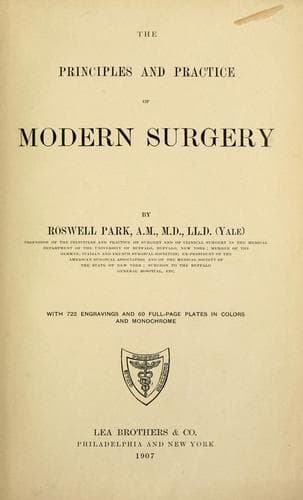
The principles and practice of modern surgeryPark, Roswell
Science
The principles and practice of modern surgery
Park, Roswell
Surgery
=Alimentary Canal.=--Probably more microörganisms enter the alimentary
canal than gain access in any other way, these coming both from food
and drink as well as air. Once within its confines, few of them are
capable of prolonged existence. Welch states that the meconium of
newborn infants is sterile, but that within twenty-four hours it
usually contains abundant bacteria. That bacterial infection through
this passage-way is a fertile source of non-surgical lesions is well
known. The possibility of surgical infections being produced in
the same way is both more remote and less demonstrable. Naturally,
anaërobic organisms find here more favorable conditions, and even
extremely acid or extremely alkaline conditions do not serve to destroy
all such life. Pyogenic cocci are often present and are frequently
found in peritoneal exudates. In the intestines of herbivorous animals
the tetanus bacilli and those of malignant edema are regularly found.
The fungus of actinomycosis also finds its way into the bowel along
with ingested food. Under ordinary conditions the bile in its natural
reservoirs is free from bacteria, but the colon bacilli and pyogenic
cocci often invade these precincts.
=Genito-urinary Tract.=--Even the healthy urethra may contain bacteria.
While these may wander upward to an indefinite extent, it is believed
that the urine contained within the bladder in a condition of perfect
health is free from bacteria, and that if such gain entrance they do
not long remain. The same is true of the female bladder and urethra.
The vagina contains organisms of many species, some of which do not
grow on ordinary culture media, but are to be recognized by the
microscope. While it is generally acknowledged that the vaginal
secretion is, as a rule, possessed of bactericidal properties, there is
as yet no satisfactory nor comprehensive explanation of this fact, its
normal acidity not being sufficient to account for the fact.
=The Milk in the Lacteal Ducts.=--In a condition of perfect health milk
secreted from the ideal mammary gland is sterile, but may easily become
contaminated upon its exit from the nipple. Conversely, under many
favoring conditions organisms may travel into the lacteal ducts from
the skin without, and thus contaminate the milk. In all probability
the breast corresponds in behavior to other glands whose ducts open
upon the surface, and, while such openings invite entrance of bacteria,
their migrations do not extend far from the surface unless some of the
other conditions already mentioned predispose to further infection or
extension.
In summarizing the general topic of possible _sources_ and _paths of
infection_ bacteria may enter and exert deleterious action:
A. _From within the system_; and
B. _From without_.
Public-domain text, read in full here on John Shaqi.
Reviews
Reviews
No reviews yet
Be the first to share your thoughts on this work.
Elsewhere in the archive
Join the Discussion
Join the discussion
Sign in to leave a comment or review.
Sign InorCreate an account