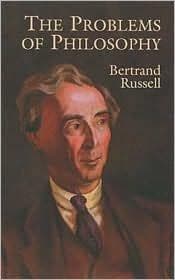
Knowledge, Theory of; Metaphysics; Philosophy -- Introductions
Another class of intuitive judgements, analogous to those of sense and
yet quite distinct from them, are judgements of _memory_. There is some
danger of confusion as to the nature of memory, owing to the fact that
memory of an object is apt to be accompanied by an image of the object,
and yet the image cannot be what constitutes memory. This is easily seen
by merely noticing that the image is in the present, whereas what is
remembered is known to be in the past. Moreover, we are certainly able
to some extent to compare our image with the object remembered, so
that we often know, within somewhat wide limits, how far our image is
accurate; but this would be impossible, unless the object, as opposed to
the image, were in some way before the mind. Thus the essence of memory
is not constituted by the image, but by having immediately before the
mind an object which is recognized as past. But for the fact of memory
in this sense, we should not know that there ever was a past at all,
nor should we be able to understand the word 'past', any more than a man
born blind can understand the word 'light'. Thus there must be intuitive
judgements of memory, and it is upon them, ultimately, that all our
knowledge of the past depends.
The case of memory, however, raises a difficulty, for it is notoriously
fallacious, and thus throws doubt on the trustworthiness of intuitive
judgements in general. This difficulty is no light one. But let us
first narrow its scope as far as possible. Broadly speaking, memory is
trustworthy in proportion to the vividness of the experience and to its
nearness in time. If the house next door was struck by lightning half a
minute ago, my memory of what I saw and heard will be so reliable that
it would be preposterous to doubt whether there had been a flash at
all. And the same applies to less vivid experiences, so long as they are
recent. I am absolutely certain that half a minute ago I was sitting in
the same chair in which I am sitting now. Going backward over the day,
I find things of which I am quite certain, other things of which I am
almost certain, other things of which I can become certain by thought
and by calling up attendant circumstances, and some things of which I
am by no means certain. I am quite certain that I ate my breakfast this
morning, but if I were as indifferent to my breakfast as a philosopher
should be, I should be doubtful. As to the conversation at breakfast,
I can recall some of it easily, some with an effort, some only with a
large element of doubt, and some not at all. Thus there is a continual
gradation in the degree of self-evidence of what I remember, and a
corresponding gradation in the trustworthiness of my memory.
Public-domain text, read in full here on John Shaqi.
Reviews
Reviews
No reviews yet
Be the first to share your thoughts on this work.
Elsewhere in the archive
Join the Discussion
Join the discussion
Sign in to leave a comment or review.
Sign InorCreate an account