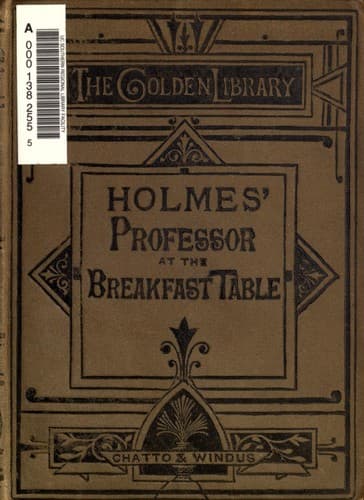
The Professor at the Breakfast-TableHolmes, Oliver Wendell
General
The Professor at the Breakfast-Table
Holmes, Oliver Wendell
American fiction -- 19th century; Conversation -- Fiction; Poetry
Iris, my dear!--exclaimed another voice, as of a female, in accents
that might be considered a strong atmospheric solution of duty with very
little flavor of grace.
She did not move for this address, and there was a tableau that lasted
some seconds. For the young girl, in the glory of half-blown womanhood,
and the dwarf, the cripple, the misshapen little creature covered with
Nature's insults, looked straight into each other's eyes.
Perhaps no handsome young woman had ever looked at him so in his life.
Certainly the young girl never had looked into eyes that reached
into her soul as these did. It was not that they were in themselves
supernaturally bright,--but there was the sad fire in them that flames
up from the soul of one who looks on the beauty of woman without hope,
but, alas! not without emotion. To him it seemed as if those amber gates
had been translucent as the brown water of a mountain brook, and through
them he had seen dimly into a virgin wilderness, only waiting for the
sunrise of a great passion for all its buds to blow and all its bowers
to ring with melody.
That is my image, of course,--not his. It was not a simile that was
in his mind, or is in anybody's at such a moment,--it was a pang of
wordless passion, and then a silent, inward moan.
A lady's wish,--he said, with a certain gallantry of manner,--makes
slaves of us all.--And Nature, who is kind to all her children, and
never leaves the smallest and saddest of all her human failures
without one little comfit of self-love at the bottom of his poor ragged
pocket,--Nature suggested to him that he had turned his sentence well;
and he fell into a reverie, in which the old thoughts that were always
hovering dust outside the doors guarded by Common Sense, and watching
for a chance to squeeze in, knowing perfectly well they would be
ignominiously kicked out again as soon as Common Sense saw them, flocked
in pell-mell,--misty, fragmentary, vague, half-ashamed of themselves,
but still shouldering up against his inner consciousness till it
warmed with their contact:--John Wilkes's--the ugliest man's in
England--saying, that with half-an-hour's start he would cut out the
handsomest man in all the land in any woman's good graces; Cadenus--old
and savage--leading captive Stella and Vanessa; and then the stray line
of a ballad, “And a winning tongue had he,”--as much as to say, it is
n't looks, after all, but cunning words, that win our Eves over,--just
as of old when it was the worst-looking brute of the lot that got our
grandmother to listen to his stuff and so did the mischief.
Public-domain text, read in full here on John Shaqi.
Reviews
Reviews
No reviews yet
Be the first to share your thoughts on this work.
Join the Discussion
Join the discussion
Sign in to leave a comment or review.
Sign InorCreate an account