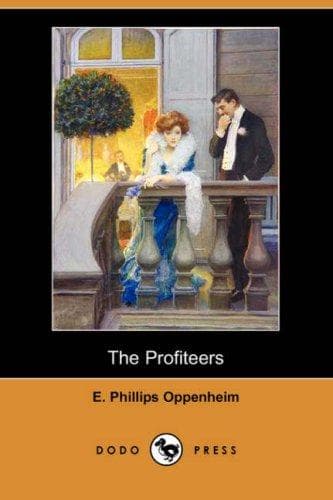
The ProfiteersOppenheim, E. Phillips (Edward Phillips)
General
The Profiteers
Oppenheim, E. Phillips (Edward Phillips)
Detective and mystery stories
"I have been down below in Stanley's rooms," he explained, "been through
his papers. It's true what the inspector fellow reports. There isn't a
scrap of evidence of any complication in his life. There isn't a shadow
of doubt in my mind as to the cause of his disappearance."
"Indeed!" Wingate murmured.
"It's a villainous plot, engineered by you!" Phipps continued, his
voice shaking. "I'm fond of the boy. That's why I've come to you. Name
your terms."
Wingate indulged in a curious bout of silence. He took a pipe from a
rack, filled it leisurely with tobacco, lit it and smoked for several
moments. Then he turned towards his unwelcome companion.
"I am debarred by a promise made to myself," he said coldly, "from
offering you any form of hospitality. If you wish to smoke, I shall not
interfere."
Phipps shook his head.
"I have not smoked all the evening," he confessed, "I cannot. You are
right when you say that we are not beaten, but I like to look ahead. I
want to know your terms."
"You are anxious about your nephew?"
"Yes!"
"And why do you connect me with his disappearance?"
Phipps gave a little weary gesture.
"I am so sick of words," he said.
"We will argue the matter, then," conceded Wingate, "from your point of
view. Supposing that your nephew has been abducted and is held at the
present moment as a hostage. It would be, without doubt, by some person
or persons who resented the brutality, the dishonesty, the foul
commercial methods of the company with which he was connected. An
amendment of those methods might produce his release."
"And that amendment?"
Wingate picked up a newspaper and glanced at it, pulled a heavy gold
pencil from his chain and made a few calculations.
"Your operations in wheat," he said, "have brought the loaf which should
cost the working man a matter of sevenpence up to two shillings. You seem
to have dabbled in a good many other products, too, the price of which
you have forced up into the clouds,--just those products which are
necessary to the working man. But we will leave those alone, if you were
to sell wheat at forty-five per cent less than to-day's price, I should
think it extremely likely that Stanley Rees would be able to dine with
you to-morrow night."
"You are talking like a madman," Phipps declared. "It would mean ruin."
"How sad!" Wingate murmured. "All the same, I do not think that you will
see your nephew again until you have sold wheat."
"You admit that you are responsible, then?" Phipps growled.
"I admit nothing of the sort. I am simply speculating as to the possible
cause of his disappearance. If I had anything to do with it, those would
be my terms. To-morrow they might be the same; perhaps the next day.
But," he went on, with a sudden almost fierce break in his voice, "the
day after would probably be too late. There are a great many hungry
people in the north. There are a great many who are starving. There is
one in London who is beginning to feel the pangs."
Public-domain text, read in full here on John Shaqi.
Reviews
Reviews
No reviews yet
Be the first to share your thoughts on this work.
Elsewhere in the archive
Join the Discussion
Join the discussion
Sign in to leave a comment or review.
Sign InorCreate an account